

5 More Negotiation Concepts Every Salesperson Should Master

If you know how to sell, you already know how to negotiate, right?
Not so fast. It’s not quite that simple.
Recently, we posted another article titled Five Negotiation Concepts That Every Salesperson Should Master. In it, we listed five basic negotiation principles that will elevate your negotiation skills while both protecting your margin and your valued customer relationships. They were:
- Collaborate and “Grow the Pie”
- Practice Deep Questioning
- Remember the Issues and Pressures on the Other Side
- Protect Profit Margin
- Resolve Concerns
While these are a good start and are fundamental to modern “win-win” negotiation training, let’s explore five more concepts and tools to elevate your negotiation game, give you deeper confidence, and strengthen your relationship-focused negotiating skills.
1. Creative Concession-Making

Every negotiation eventually arrives at the moment where concessions are requested and granted. Don’t panic. Concessions are a good thing – if handled correctly. Strategic concessions can be powerful. But remember that creative concession-making is not about giving away something for nothing. It’s about finding ways to build more value into the deal for all parties via a balanced give-and-take approach.
- Always Exchange, Never Just Give. Successful negotiators understand that every concession should be reciprocal. What’s good for the goose is good for the gander, right?
- If your customer wants a better price, you can ask for a higher volume to meet that discount threshold. Or gain commitment to be the supplier of choice for another product, as well.
- If they want special or expedited handling and delivery, you can ask them to pay for it.
- If they still say it’s not in their budget, you can offer them a less expensive (albeit lower quality) option or reduced services.
- Protect Margins. You and your company live or die by the margin you generate and protect. Craft concession trades that maintain or even enhance deal value for your company.
- Offer to include extra services that cost you little but have high value for the customer.
- Encourage contracts and partnership programs that guarantee long-term business beyond low-margin commodities.
- Sometimes lower-priced items actually have higher margins. If it meets the customer’s needs, consider guiding them towards higher margin products rather than just the more expensive ones.
Example: 100 of a $20 product at a 20% margin = a $2,000 order and $400 profit. 100 of a $15 product at a 66.67% margin = a $1,500 order and a $1,000 profit.
- Communicate. Highlight the value of your concessions, making sure the client understands what’s being offered and its importance.
- Try to assign or at least estimate what your concessions are worth to the customer. Not what they cost you.
- Don’t be afraid to share that you are willing to look for opportunities to make concessions – but only if it’s a two-way street.
- Move Slowly and Purposefully. Avoid instantly agreeing to requests. An authentic pause allows you time to consider the request, increases the perceived value of concessions, and sets positive expectations for future negotiations.
Negotiation training can help you learn the principles of creative concession-making, but the key is repeated and consistent practice. Creative and strategic concession-making is the mark of a seasoned, customer-centric professional and strengthens your Credibility at the negotiating table.
2. Persuasion Techniques: Ethos, Pathos, and Logos
And speaking of credibility, developing and displaying credibility is one of the three pillars of Influence and Persuasion that Aristotle laid out more than 2,300 years ago. He called them Ethos, Pathos, and Logos, but we know them as Credibility, Emotion, and Logic.
- Credibility (Ethos). Credibility is more than knowing your product and the number of years you have been on the job. Knowledge and experience are crucial, but credibility is also about building trust, being an authentic and reliable partner. And remember that credibility is earned, not given, and once lost, can be difficult to restore.
- Emotion (Pathos). Effective negotiators listen for and tap into the emotions driving the deal. Whether it’s alleviating a client’s fears or channeling their enthusiasm, emotional intelligence is a persuasive force. But again, beware. Inauthentic and superficial emotional appeals are instantly recognized as manipulative and can poison not only the deal but the relationship as well.
- Logic (Logos). Our first pass is usually to assume that a logical position will save the day. There’s no question that clear, structured arguments grounded in data and practical reasoning are required. Use case studies, ROI calculations, and well-crafted narratives that lead to a logical conclusion. Just don’t rely solely on logical arguments.
But what is the most effective of the Three Pillars of Persuasion? It’s the one that resonates most clearly with your buyer at any given point in time.
- Today, a buyer might be particularly sensitive to Credibility – because another long-term, stable supplier is going out of business.
- The next day, Emotion is running high because they are distraught after being unable to squeeze an extra 3% out of an invoice or bill of materials they have already put to bed.
- The following day, they need to just work through the Logic of a complicated delivery schedule.
Same buyer, potentially different points of persuasion to help you be on the same wavelength with what they are feeling.
3. Strengthen Relationships
One-off deals may be won or lost in a single conversation, but lasting success is forged through strong, trust-based relationships. The best negotiators view every engagement as a relationship-building opportunity.
- True Empathy. Understand and acknowledge the client’s perspectives and concerns. Empathy fosters rapport and signals a partnership mentality, not a transactional one.
- Active Listening. Ask open-ended questions and then truly listen. Let your client feel heard before launching into persuasion.
- Rapport-Building. Simple gestures, such as remembering personal details or sharing a quick, non-business story, help to forge a connection.
- Find Common Ground. Show genuine interest in the other party’s objectives and share your goals, looking for opportunities to frame proposals around their needs while advancing your own interests.
- Transparent Communication. Always follow through on commitments and be clear about what can and cannot be done. Reliability breeds trust.
- Collaboration over Competition. Aim for win-win rather than zero-sum outcomes, exploring mutual interests to maximize value for both sides.
Sales-focused negotiation training emphasizes relational skill-building as a core competency for high achievers.

4. Negotiation Parameters
There are specialized terms and vocabulary to describe several benchmarks and tools used to plan and evaluate the progress of specific negotiation interactions.
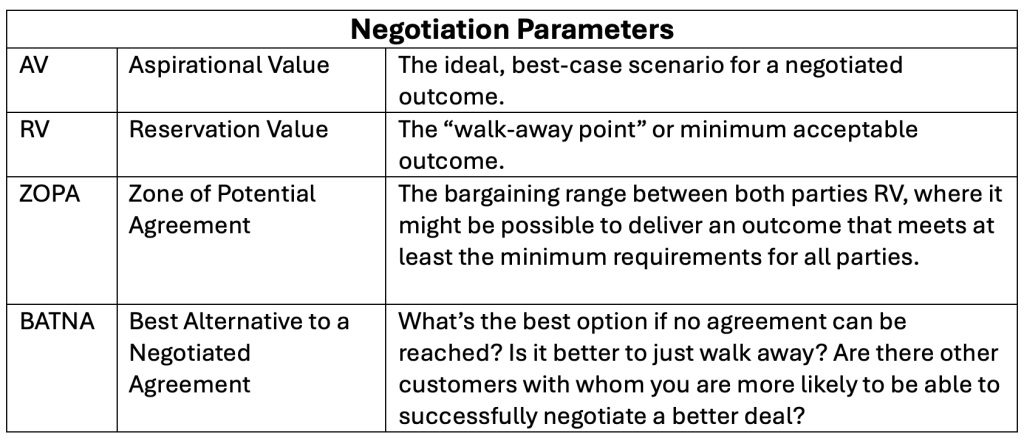
Remember to:
- Assess your parameters before negotiations begin.
- Estimate your counterpart’s parameters to gauge the overlap (ZOPA).
- Revisit and revise your BATNA as circumstances change.
Use these concepts as a barometer to define boundaries and gauge results and options against your expectations at the beginning and throughout a negotiation.
5. Bundling
Bundling involves packaging multiple products, services, or issues together to create a deal that delivers higher perceived value to both sides.
Presenting multiple, well-developed options empowers clients, demonstrates flexibility, and reduces pressure on a single offer. The psychology of choice can play heavily into your counterpart’s perception of the value of your proposal.
Why Bundling Works
- It allows for trade-offs that are impossible with single-issue deals.
- Creates opportunities for creative solutions and expanded value.
- Reduces deadlock over individual items – success can often be found in the sum, not the parts.
Present Alternatives. Everyone welcomes the ability to consider multiple options. Two options are appreciated. Three options are even better and underline your willingness to try to be flexible, while at the same time putting the ball in their court to be equally flexible and responsive.
Tiered Options. Presenting “good, better, best” options gives your counterpart a framework to understand that while a deal can be put together in several ways, each bundled “package” must maintain balanced value for both sides. Consider a variety of potentially mutually agreeable packages, varying in features, terms, or pricing, ahead of time to ensure you are protecting your margin and relationships in each scenario.
The Role of Negotiation Training
Nothing can replace actual negotiation experience in the field. But role-playing and negotiation training amplify your ability to apply advanced techniques consistently. Top programs blend real-world scenarios, feedback, and behavioral insights, helping sales teams integrate these negotiation tools and strategies into their daily activities.
Go beyond the basics of negotiation. Embrace creative concession-making, persuasion (Ethos, Pathos, Logos), relationship-building, clear negotiation parameters, and bundling. They will deepen client loyalty, protect profitability, and create solutions that are valuable to all involved.
Want to Win More Deals Without Sacrificing Margin?
Negotiation Quotient teaches sales teams how to defend against price pressure, respond to buyer tactics, and create win-win outcomes that protect profitability. Trusted by top-performing teams, this training delivers real-world strategies that stick, leading to fewer discounts and stronger customer relationships.
Request a Demo to see how Negotiation Quotient can elevate your team’s negotiation performance.

Previous
Next