

Why the GROW Model is Not Sufficient for Sales Coaching & Driving Growth

Introduction
As the old saying goes, sometimes I think I’m a glutton for punishment. The GROW model has a lot of fans, is very popular, and is respected and used by many. I’m sticking my neck out a bit here and might take some heat for this.
Even so, that doesn’t change my opinion. I should, however, probably start by disclaiming that I have a lot of respect for the GROW model, too, and the intent behind it. I do not intend to bash it, trash it, or disparage it in any way. I do intend to make a case that it is not the best model for sales coaching, specifically. Not because there is something inherently wrong with GROW, but because it is simply not specific enough to foster behavior change and drive sales performance. It is not detailed enough; it is not a full coaching system.
Let’s start by exploring GROW, for those who may not be familiar with it.
Overview of the GROW Model
The GROW model is a widely used coaching framework designed to help individuals and teams achieve their goals and improve performance. The acronym GROW stands for:
- Goal: What do you want? Define what you want to achieve.
- Reality: Where are you now? Assess the current situation and identify obstacles.
- Options: What could you do? Explore possible strategies and solutions.
- Will: What will you do? Develop a plan of action and commit to it. (“Will” is the W intended by its creators, but today I often see W described as “Way Forward.”)
Goal: This stage involves setting clear, specific, and achievable goals. The coach helps the coachee articulate what they want to accomplish, ensuring the goals are motivating and aligned with their values.
Reality: Here, the coach and coachee examine the current situation. This includes understanding the context, identifying challenges, and recognizing any limiting beliefs or behaviors. The aim is to gain a realistic view of where the coachee stands in relation to their goals.
Options: In this phase, the focus is on brainstorming and exploring various strategies to overcome obstacles and achieve the goals. The coach encourages creative thinking and helps the coachee consider different perspectives and resources.
Will: The final stage involves creating a concrete action plan. The coachee decides on the specific steps they will take, sets timelines, and identifies any support they might need. This stage emphasizes accountability and commitment to the plan.
To be fair, there is more to GROW and a lot of good psychology behind it. The book discusses:
- High-performance culture
- The performance curve (sort of a maturity model)
- The coaching mindset with partnership and collaborations
- Trust, and without specifically using this term, psychological safety
- Questioning skills and active listening
There is a lot of goodness in GROW, and if you were doing executive coaching, personal coaching, mentoring, or general coaching, I’d highly recommend it. In fact, these five bullets and more from GROW are also represented and encouraged in my sales coaching system.
Brief History of the GROW Model
For history buffs, the GROW model was developed in the 1980s by Sir John Whitmore and his colleagues at Performance Consultants International. It was influenced by the Inner Game method created by Timothy Gallwey, which focused on overcoming internal obstacles to performance. Whitmore’s book, Coaching for Performance, first published in 1992, played a significant role in popularizing the model.
The model was co-developed with Graham Alexander and Alan Fine, who contributed to refining its structure and application. Over the years, the GROW model has become a cornerstone in the fields of business coaching, executive coaching, personal development, and leadership training.
My Sales Coaching System
This is my Sales Coaching System taught in my Sales Coaching Excellence course (SCE):
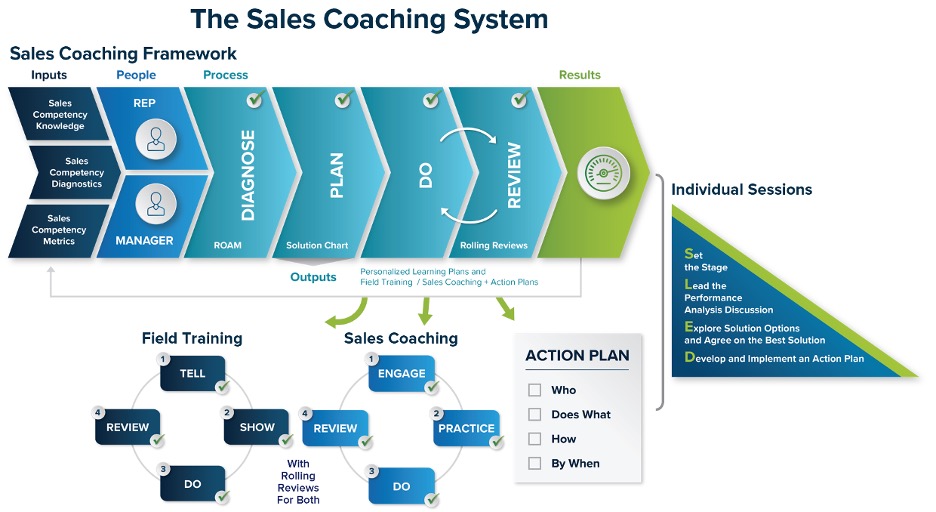
Let’s discuss what I believe the key differentiators are, that make SCE a far more effective approach for sales coaching, specifically.
My Sales Coaching System vs. GROW – Key Differentiators
Data-Driven Focus
My Sales Coaching System, or Sales Coaching Excellence (SCE), teaches managers to their available sales analytics and reporting to pinpoint high impact coaching areas, ensuring time spent directly improves performance. Can this be done in GROW? Sure. Is it a purposefully included part of the model? No. GROW encourages engagement and participation from the coachee, as does SCE, but does not specifically use data-driven approaches, and banks on the employee wanting to improve or being able to determine what to focus on. Blind spots, cognitive biases, and Dunning-Kruger all often get in the way of this working, which is why engaging the employee AND having the manager do the analysis as well, works better in many cases, to target areas for meaningful growth.
Root-Cause Diagnosis
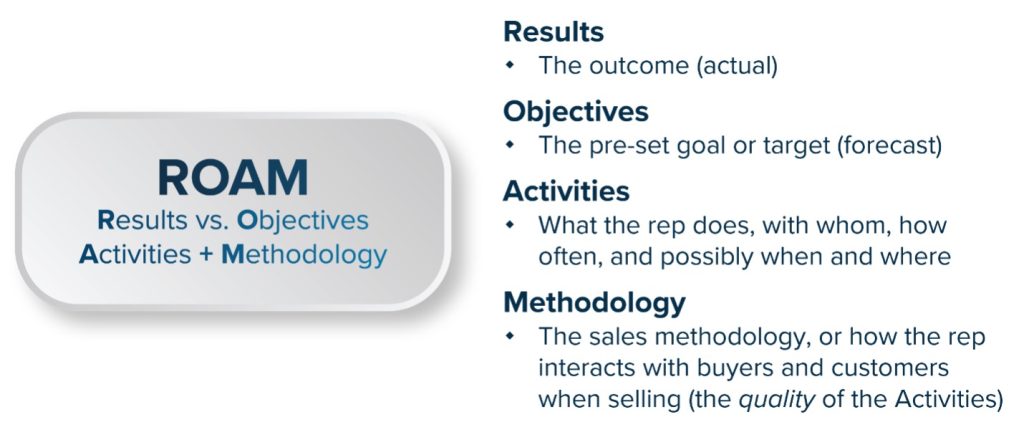
Unlike GROW’s broader approach, SCE employs very specific diagnostic approaches and tools to get to a root-cause for the performance gap or the area to improve (if it’s not a gap – it might just be an opportunity for growth). ROAM helps with this. Comparing Results vs. Objectives identifies areas of shortfall or possible improvement (remembering that it’s not always about fixing problems). Then, reviewing the Activities performed to get the current Results and the Methodology used (meaning the quality of how the Activities are executed), to determine what’s being done currently and what can be improved.
Tailored Solutions
SCE differentiates between training, coaching, counseling, feedback, and other interventions, ensuring managers address the actual root cause with the right approach. The Solutions Chart helps managers identify whether mindset, behavior, or skills gaps are the real issue, and whether training, coaching, counseling (coaching applied to mindset and beliefs), or feedback is the best solution, or whether it’s something else entirely, such as managing consequences or addressing other constraints.
Examples of Two Solutions Charts (The one on the right is from SCE)

Structured Models
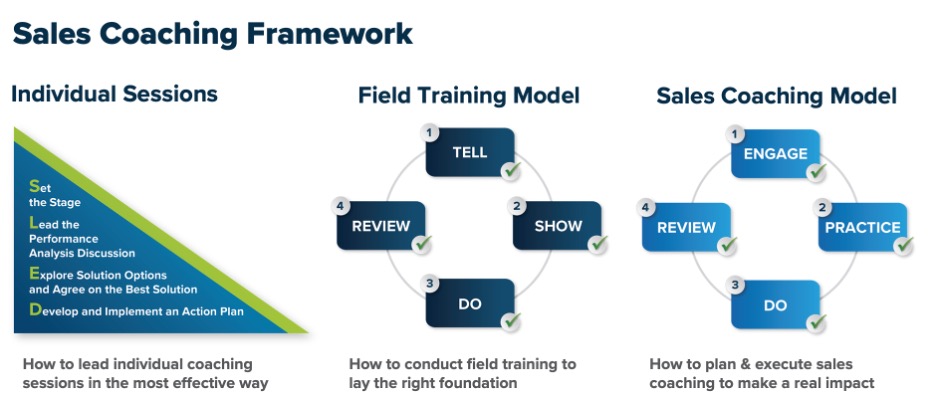
SCE offers a 4-step model for leading the coaching session (SLED), and then a model for field training (Tell, Show, Do, Review with Understanding Checks) and a model for coaching (Engage, Practice, Do, Review with Understanding Checks), and ongoing review cycles (Rolling Reviews). These models are designed to improve skills and systematically remove excuses for non-performance to foster behavior change and drive measurable outcomes through continuous improvement. SCE guides managers to be directive, when it’s required (if someone doesn’t know what, why, or how to do something well) and when to facilitate and guide, actively engaging the employee (if they know what, why, and how but just need to improve how well they do it). The field training and sales coaching models also purposefully involve role play or deliberate practice (in the Show and Practice steps), and the Understanding Checks remove all doubt about whether expectations are clear and understood, and whether the employee can do what they have been trained or coached.
Closing Thoughts
If you understand Performance Consulting, you probably notice the similarities to the approach in the Sales Coaching System in SCE:
- Problem Worth Solving
- Diagnostics / Gap Analysis
- Root-Cause Analysis
- Problem-Solving / Solution Design
- Solution Development
- Solution Implementation with Change Management
- Measure / Evaluate / Adjust
Without knowing about performance consulting, this is exactly what I have observed top-performing sales managers and outstanding coaches do differently than the average managers and coaches. They are far more targeted, analytical, and thoughtful in how they coach. And the very best get into a cadence of continuous improvement. And as with GROW, they do encourage their employees to own their development, get engaged, foster psychological safety, and provide a supportive environment for learning, growth, and performance. They just execute in a far more detailed and disciplined way. GROW just leaves too much to chance.
And this is why I believe, as good as GROW is for some forms of coaching, that what we teach in Sales Coaching Excellence is far superior for sales coaching.
You can read Mike’s original post here.

Previous
Next