

Thoughts on Resolving Price Concerns

Today, I want to talk about something a bit more tactical than usual, but important. What is it? It’s about pricing, pricing concerns, and how to help resolve them when they arise.
Introduction
Today, I want to talk about something a bit more tactical than usual, but important. What is it? It’s about pricing, pricing concerns, and how to help resolve them when they arise.
Introduction
Price is the number 1 reason salespeople give for losing an opportunity.
Knowing that, here’s an interesting factoid: Corporate Visions’ TruVoice Analysis (win-loss analysis) of over 100,000 deals found that:
Sellers’ and buyers’ reasons for losses differ 50% to 70% of the time.
Now, that could be because buyers don’t feel comfortable telling sellers the truth, or it could be because reps lack self-awareness (aka, have no clue). Likely it’s a bit of both, but in either case, that gap is huge and worrisome.
Thirdside is another firm that has conducted hundreds of in-depth B2B buyer interviews with decision makers across multiple industries and company sizes. They reported that:
A majority of losses can be attributed, at least in part, to the buyer not feeling understood.
That syncs with this chart, which I display regularly.
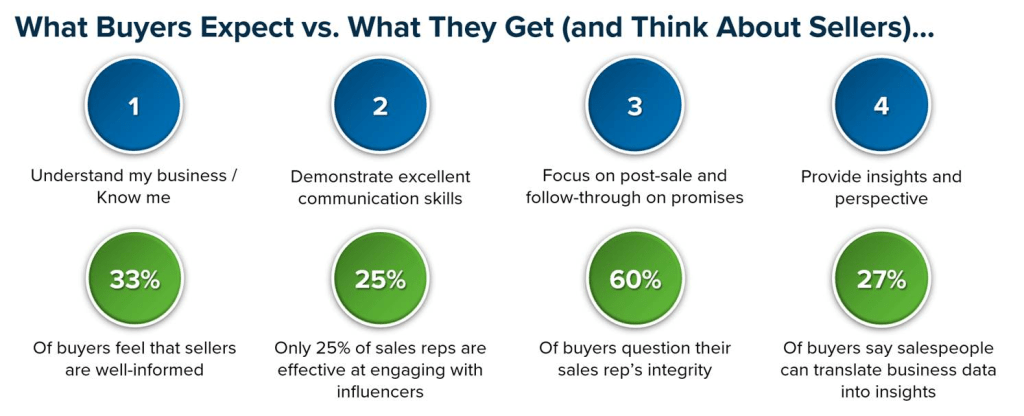
While those mistakes (not understanding your buyers or their true needs) often show up as “price” or “competition” losses in your CRM, the real failure happened far earlier, when discovery was done poorly or incompletely.
Feeling understood remains one of the deepest-seated human needs and applies in business just as much as in our personal lives.
The Seller’s vs. The Buyer’s Perspective
When deals are lost, sellers often cite reasons such as:
- The price was too high.
- A competitor had a better solution.
- The buyer “went in another direction.”
However, buyers interviewed in win-loss analyses give different reasons, pointing to correctable mistakes made by the seller:
- Weak discovery: The sales team failed to understand the buyer’s COIN-OP* and didn’t make them feel heard.
- Lack of differentiation: The seller could not effectively distinguish their product or service from the competition.
- Poor value communication: The salesperson did not make the value proposition clear or didn’t communicate and confirm value from the buyer’s perspective.
* COIN-OP = Challenges, Opportunities, Impacts, Needs, Outcomes, and Priorities
Research from LeveragePoint has shown that the first vendor to paint a vision of value wins the business 74% of the time.
Get to the Root Cause
What’s the bottom-line here?
If you’re consistently hearing from your sellers that price is the problem and the reason they’re losing deals, talk to your buyers and conduct a win-loss analysis through a reputable third-party expert (you’ll get more reliable insights).
Before you take action, you’ll want to get to the root cause. It could be:
- A legitimate pricing problem.
- Partially a pricing issue compounded by something else.
- The salesperson didn’t truly understand the buyer’s situation and what they needed.
- A price-to-value gap (value was too low from the buyer’s perspective).
- Something that is missing in your solution that buyers want.
- Something that’s in your solution that they don’t like.
- Poor value engineering and value communication.
- A negotiating skills gap.
- A trust gap between your salespeople and your buyers.
- Inability to resolve concerns effectively.
- Buying friction (you make it hard to buy–you’re in the Sales Prevention Business).
- Or something else entirely.
As Albert Einstein famously said (paraphrased):
“If I had an hour to solve a problem, I’d spend 55 minutes defining it.”
Fixing What Sellers Can Control
If there is a legitimate pricing issue, something missing from the product or something in it that buyers don’t like, or buying friction caused by company policies or leaders, you are hamstringing your sales force. It’s like the old joke, “It’s not you, it’s me.” If you’re an executive, fix it. If not, escalate it. And if the company won’t address these issues – my advice is to get out. You’ll just be moving the deck chair around on the Titanic.
In terms of enabling your sales force, however, there are several things you can do that are within their control. When the problems include:
- The salesperson didn’t truly understand the buyer’s situation and what they needed.
- A price-to-value gap (value was too low from the buyer’s perspective).
- Poor value engineering and value communication.
- A negotiating skills gap.
- A trust gap between your salespeople and your buyers.
- Inability to resolve concerns effectively…
…these things can be taught, reinforced, coached, and fixed.
Understanding What Matters Most
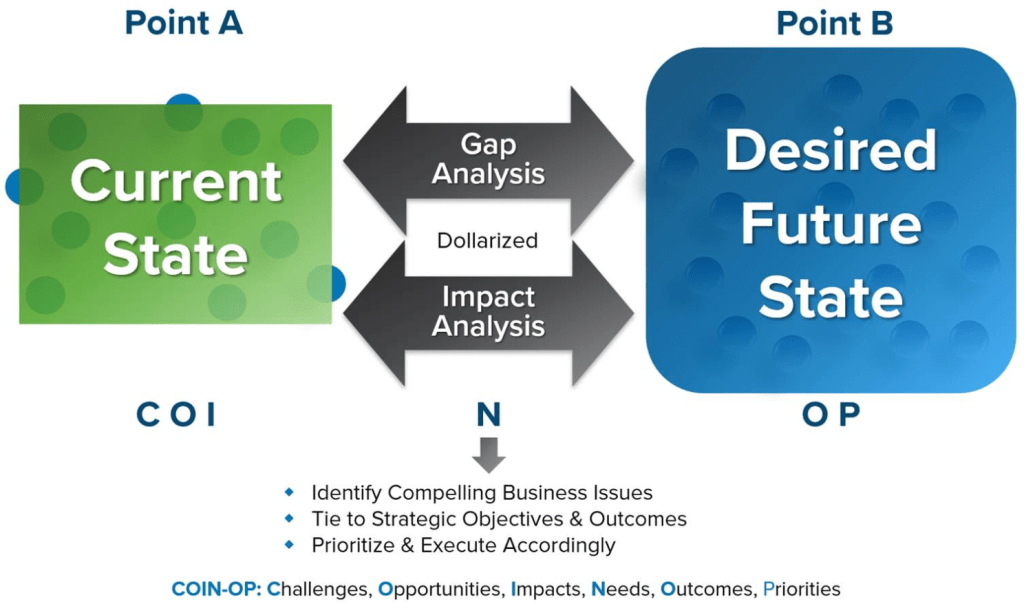
This starts with discovery – or what we call a Situation Assessment in Modern Sales Foundations. It’s not just about asking questions. It’s about deeply understanding the buyer’s COIN-OP:
- Challenges they face.
- Opportunities they want to seize while they can.
- Impacts of not resolving those challenges or of missed opportunities.
- Needs they’ve identified (and those they haven’t) – what will close the gap between the Current and Desired Future States.
- Outcomes they want to achieve.
- Priorities of the Needs and Outcomes.
When sellers master COIN-OP, they stop pitching and start solving. They make buyers feel heard, understood, and valued – which, as we’ve seen, is often the real reason deals are lost. This is the foundation for everything that follows.
Keep in mind that COIN-OP was designed for a B2B complex sale, but it also can flex. It can be used lightly in an over-the-counter discussion to select the right pneumatic power tool, or in a conference room or web conference, to deeply understand an adaptive problem to be solved by an Industrial IoT solution – and everything in between.
Value Engineering
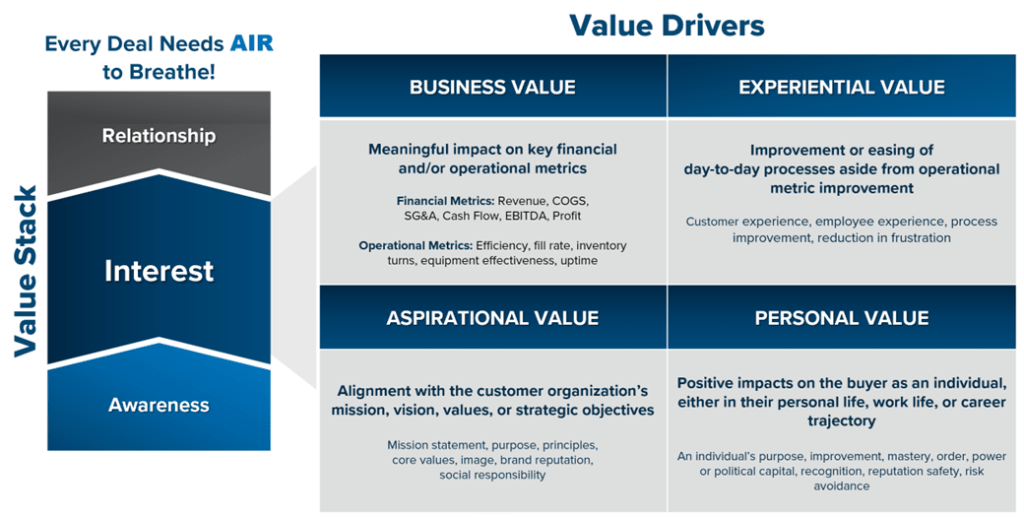
I’ve published a full edition of Sales Enablement Straight Talk on Value Engineering, so I won’t rehash all the details here.
Here’s the short version: Value Engineering is about co-creating value with your buyers. It’s not just about your solution – it’s about how your solution helps them achieve their desired outcomes. It’s about aligning your capabilities with what they need and want, and their priorities – making the value crystal clear from their perspective.
When done well, Value Engineering closes the price-to-value gap and makes pricing concerns far less relevant. Check out this edition for more: Value Engineering for Opportunity Management & Account Growth
Negotiating Skill
Negotiation is often misunderstood. It’s not about haggling or playing hardball — it’s about collaborative problem-solving. That’s why Negotiation Quotient is part of the Modern Sales Foundations family of courses.
Negotiation includes:
- Self-Preservation: Understanding how to identify, deflect, and redirect tactics when well-trained buyers use them on you.
- Preparation: Understanding the buyer’s COIN-OP and your own value levers.
- Positioning: Framing your offer in buyer-centric terms.
- Focus: Zero in on interests, not positions, and on “growing the pie” to create win-win outcomes.
- Flexibility: Knowing where you can give and where you must hold firm (things like BATNA and ZOPA — Best Alternative to a Negotiated Agreement and the Zone of Possible Agreement).
- Communication: Managing tone, timing, and transparency. Finding the balance between creating value and claiming value and the challenge of balancing cooperative and competitive strategies (aka, The Negotiator’s Dilemma).
- Resolution: Finding win-win outcomes that preserve margin and trust.
Possibly the most important point about negotiation, relative to resolving price concerns, is to not negotiate until value selling is done.
When you have understood, co-created, and communicated value that your buyer has confirmed and accepted, and you still can’t resolve a price concern, then it is time to negotiate. Negotiate prematurely, and you will almost always make concessions you don’t really need to and reduce your profitability and margin. Plus, the buyer will likely nibble you into non-existence.
When sellers negotiate well, at the right time, they don’t just close deals—they build relationships, deliver outcomes, and protect profitability.
Read more:
Building Credibility and Trust
Trust gaps are real — and they’re often rooted in early missteps. Buyers want to work with sellers who:
- Understand them and their business.
- Ask insightful questions.
- Listen actively.
- Share valuable insights.
- Communicate clearly.
- Act in their (the buyers) best interest.
- Follow through on commitments.
- Tell the truth (even when it’s hard).
Credibility starts with competence and grows through consistency. Sellers build trust by doing what they say, showing up prepared, and putting the buyer’s interest first. When trust is high, and you have Need And Solution Alignment (NASA), concerns shrink, and deals accelerate.
Resolving Buyer Concerns

When concerns arise, sellers often get defensive or try to “handle” objections. That’s a mistake. Concerns aren’t obstacles — they’re opportunities to deepen understanding and build trust.
We teach the ACCRC framework to help sellers navigate these moments:
- Acknowledge the concern respectfully with empathy.
- Clarify what the buyer really means (peel the onion to get to the root).
- Categorize the concern (is it a misunderstanding, disbelief, or a real drawback you must content with?).
- Respond with relevant information, stories, or reframes. For price concerns, it’s often a redirect to focus on value.
- Confirm that the concern is resolved — or at least reduced enough — and if the buyer is willing to move forward.
This approach is collaborative, respectful, and effective. It helps buyers feel heard and supported, not sold to or pushed.
This post shares another use for ACCRC – resolving concerns with your veteran sales reps – but it’s a deeper explanation of the ACCRC framework and might be helpful: Resolve Your Veteran Reps’ Concerns About Sales Training
Closing Thoughts
As we wrap up this post, I hope you walk away with a clearer understanding of why pricing concerns often aren’t always about price – and what you can do to fix them.
We covered a lot today. From the importance of understanding your buyer’s situation through COIN-OP, to co-creating and communicating value through Value Engineering, to negotiating collaboratively, building trust, and resolving concerns with the ACCRC framework – these are the skills and practices that separate top performers from the rest.
So, here’s my challenge for you: Take a hard look at how your sales force operates. Are they truly uncovering what matters most to buyers? Are they engineering and communicating value in buyer-centric ways? Are they negotiating with skill, building trust, and resolving concerns effectively – even the dreaded price concern?
If you see gaps – and most teams have them – don’t go it alone. Reach out to me directly or use the contact form at modernsalesfoundations.com/contact. Let’s talk about how Modern Sales Foundations, Negotiation Quotient, or our new course on Resolving Price Concerns can help you close those gaps and drive real results.
This post was originally published as a LinkedIn newsletter, which you can find here.

Previous
Next