

The Teachable Elements of Sales Effectiveness That Often Aren’t Taught

Today, I want to share a truth that’s both simple and urgent: sales effectiveness — and the revenue it enables — is being lost in plain sight.
Introduction

Let’s look at some other depressing sales research stats:
- Sales Mistakes Have a High Cost: 53% of deals marked “lost” were actually winnable, if not for missteps in the sales process. This reveals gaps in our approach. (Source: Corporate Visions)
- Trusted Advisors Wanted: 87% to 88% of buyers expect sales reps to act as trusted advisors. (Sources: Salesforce, LinkedIn)
- Low Trust Levels: Only 29% of B2B buyers trust salespeople, according to Forrester. And a Harvard Business Review study found that only 18% of salespeople are trusted during the sales process.
- Perceived Lack of Value: A Gartner survey found that 72% of B2B buyers prefer a rep-free experience when looking for innovative ideas and solutions to grow their business. This suggests that buyers often feel salespeople don’t provide enough value to justify the interaction.
- Lack of Business Acumen: Buyers also perceive a lack of business acumen in salespeople, with 75% stating that sales reps don’t demonstrate knowledge of their industry structure. This suggests a gap in salespeople’s understanding of their clients’ business context. (Source: Forrester)
- Business Impact Gaps: 94% of executive buyers want salespeople to engage them in a business impact discussion, but only 19% of salespeople are effective in this regard, highlighting the importance of business acumen to bridge this gap. (Source: Brandon Hall)
- Value Communication Gaps: Only 54% of salespeople clearly explain how their solution positively impacts a customer’s business. (Source: CSO Insights)
Yet:
- The Power of Win-Loss Analysis: Companies that conduct win-loss analysis can improve close rates by up to 50%, a clear signal that insight plus adjustment drives outcomes. (Source: Gartner)
Enablement Gets Results:
- Enablement Strategy: When organizations have a dedicated sales enablement strategy, they enjoy a 49% higher win rate on forecasted deals, demonstrating that structure and preparation matter profoundly. (Source: CSO Insights/Highspot)
- Focus on Performance Targets: Organizations focused on revenue enablement are at least 75% more likely to exceed performance targets such as seller revenue, cross-sell/upsell, and revenue growth. (Source: Gartner).
- Performance Boosts: Sales enablement investments boosted sales performance in 92% of executive-reported cases, indicating broad confidence in enablement’s impact. (Source: Sales Enablement PRO)
- Training Delivers ROI: A 2020 study by Southern New Hampshire University found that salesperson training can have an ROI of up to 353%, while a separate 2020 study by the Sales Management Association found that “teams that invest in sales training and development are 57% more effective than teams that don’t”. This represents a significant potential return on investment. The study also highlights the high-end of potential ROI, stating that for every dollar invested, the monetary return can be as high as $4.53.
These statistics underscore that the gaps we’re seeing in performance aren’t random, yet the solutions are out there. (Or, for fellow X-Files fans, “The solutions are out there, Mulder.”)
The solutions to the above gaps are teachable, learnable, foundational elements, which I call the Sales Effectiveness Acumens and Sales Effectiveness Fundamentals. Unfortunately, as the above stats suggest, they often are overlooked, underdeveloped, or improperly implemented in sales organizations today. Which sometimes gets me thinking…
“I wonder if the basics that produce results are too boring for some leaders? It’s a shame they’re not bright, shiny objects.”
Mike Kunkle
Let’s explore.
What Are the Sales Effectiveness Acumens?
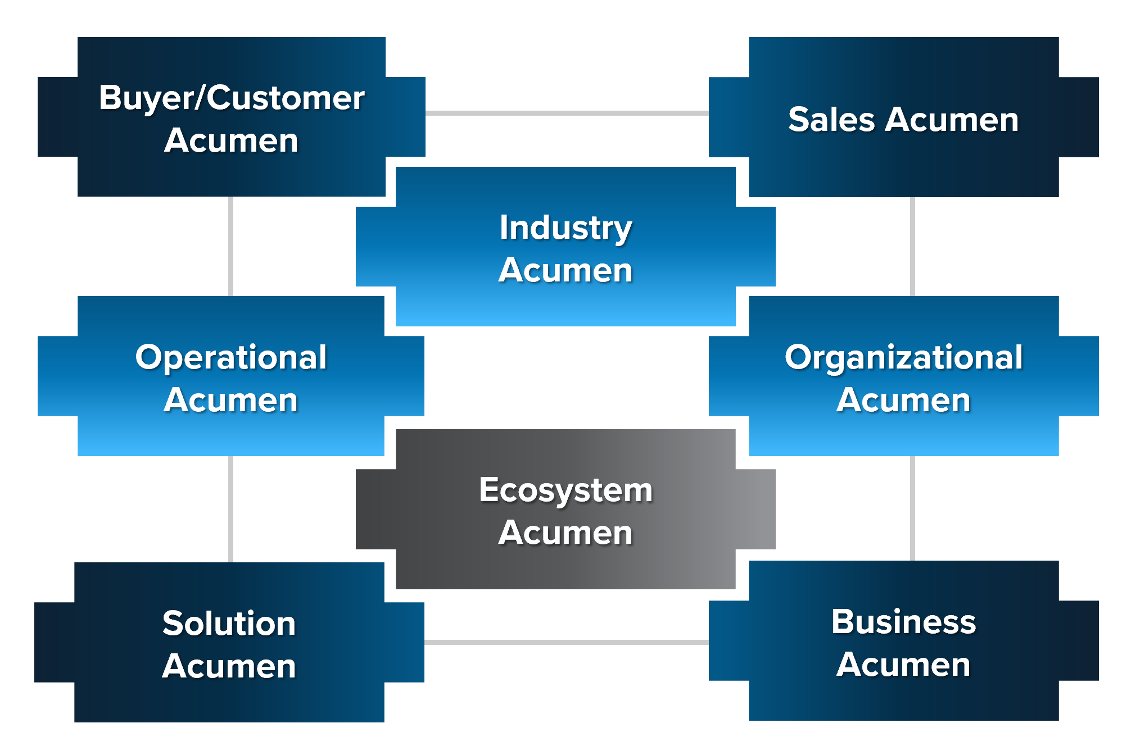
The Sales Effectiveness Acumens (SE Acumens) are the core knowledge areas and competencies that underpin a seller’s ability to execute at a high level. Without them, salespeople may appear busy, but they’re missing the insight and adaptability that drive consistent, profitable wins. They include:
- Buyer/Customer Acumen: Understanding general buyer personas and buyers’ journey or buying processes, including Challenges, Opportunities, Impacts, Needs, Objectives, Priorities (COIN-OP), decision process, decision criteria, decision roles, desired outcomes with metrics/measures, and consideration of both the decision makers’ business and personal needs.
- Sales Acumen: Includes sales research, sales call planning, prospecting/lead generation, digital selling practices, opportunity qualification, consultative selling using an adaptive sales methodology (including discovery/situation assessment, solution development/co-creating solutions, developing proposals, conducting demos and/or presenting solutions/solution dialogue, resolving concerns, and gaining commitment), sales meeting management, multi-threading to message appropriately to buyers with different interests, storytelling, insight selling, negotiating, influence skills, consulting skills, general dialogue and communication skills, team selling, and strategic account management.
- Business Acumen: Understanding business models, financial acumen, operational metrics/outcomes such as key performance indicators and critical success factors, pricing, how customer organizations make money, and how to build a business case and calculate ROI. As my friends at Advantexe so accurately put it:
“Business Acumen training helps sales professionals position themselves as trusted advisors who can help the client address their issues and opportunities.”
- Solution Acumen: Understanding of products and services and how they solve customer problems, critical thinking and problem solving, forcefield analysis, how solutions tie to Industry Acumen, Financial Acumen, Customer Acumen, and Ecosystem Acumen. This is the culmination of acumens, used to create value for customers (and differentiation for the company) to achieve customers’ desired outcomes. Includes an understanding of competitive offerings and how to position against them, as well as against DIY and the status quo.
- Operational Acumen: How to get things done: how to make things happen in your own organization and in others – includes an understanding of processes, political savvy, culture, collaboration, consensus-building, and the ability to execute on all the above plans effectively.
- Industry Acumen: This domain expertise. It’s an understanding of the industry challenges, opportunities, technologies, regulations and legislation, business practices, current events/news, and the general state of the profession.
- Organizational Acumen: How to plan and organize effectively. Includes territory planning, account planning, sales call planning, leading sales meetings, task management, using CRM, sales enablement tools, other technology tools and performance support, action planning, calendaring, project management, change management, and personal productivity practices.
- Ecosystem Acumen: As applicable, this is understanding of vendor and channel partners and how to most effectively build relationships and engage with them to uncover, manage, and win opportunities through the effective co-creation of solutions for customers. It’s the only SE Acumen that isn’t universal and is dependent on how the company goes to market.
Sales professionals with strong business acumen think like executives, understand financial drivers, and can connect their solutions to measurable business outcomes.
Real-World Examples of SE Acumen Gaps
Consider this scenario: A client’s top 10% of sellers grasped their customers’ industry shifts and pressures and personalized for them, while the rest relied on generic messaging. The result? A 30-percentage-point difference in win rates between the two groups.
I remember a team that learned negotiation techniques but lacked insight into their buyers’ business model. They regularly negotiated away value by offering concessions the buyer didn’t even want, because they were unable to link their value proposition to what really mattered to the client.
Note: This is a sign, I know, that the sellers didn’t really understand what they learned. But yes, the buyers still took the concessions anyway.
These examples demonstrate that surface-level skill without context doesn’t cut it. SE Acumens are what gives salespeople the depth needed to thrive in B2B complex sales.
What Are the Sales Effectiveness Fundamentals?

The Sales Effectiveness Fundamentals (SE Fundamentals) are the practical, repeatable activities that drive opportunity creation, deal progression, and account growth. The sales activities in the middle of this image are more well-known, but still not always done well. And the things circling those activities are either less known or less used. The Fundamentals include:
- Buyer Centricity: Being buyer centric is an outside-in mindset that considers everything you do from the buyers’ perspective. It influences your behavior to act in your buyers’ best interest, to achieve your success by supporting their success.
- Value Creation: Value creation (or better, co-creation) is your ability to understand what each buyer values and co-create solutions to deliver value and communicate the outcomes of your solution to articulate the value you deliver. Value includes Business Value, Experiential Value, Aspirational Value, and Personal Value.
- Prospecting: Prospecting is the act of researching, planning, and approaching decision maker contacts in target accounts, in such a way to successfully generate interest in exploring how you might help them achieve their goals and then setting an appointment to do so.
- Discovery: Discovery (or what I call a Situation Assessment) is the act of understanding you buyers’ situation and what matters most to the decision makers and key influencers – their current state and related impacts, their desired future state and related outcomes, and the size of the gap and the urgency to close it.

- Opportunity Qualification: Opportunity qualification is analyzing various factors of the situation that typically indicate that there is an opportunity (a problem you can solve that is compelling enough to spur action) and that you have a reasonably enough likelihood of winning the business to commit the time, energy, resources and money to pursue it.
- Opportunity Management: Opportunity management is the act of purposefully uncovering and satisfying each buyers’ decision criteria and buying process exit criteria, to successfully shepherd the opportunity through the stages of the buying and sales process to a final win decision. Negotiating is included here.

- Strategic Account Management: SAM is the act of analyzing account potential, setting account objectives, considering relationships and other factors to build an account plan that will achieve the pre-set objective, and executing that plan to achieve the objective (usually: Grow, Maintain, and Recover, but can include Retire).
- Sales Call Planning: Sales call planning is the act of setting sales call objectives and then creating a plan to achieve them.
- Resolving Concerns: Buyers and customers may express various concerns at any stage of the buying process or customer lifecycle. Resolving concerns is the act of following a buyer-centric process to acknowledge and clarify their issues to identify the type of concerns they have, so you can offer relevant perspectives and recommendations to effectively address them.

- Territory Management: Territory management is the act of analyzing the accounts and potential within your territory, however it is structured, to ensure proper account coverage and to optimize the potential of your territory.
- Account Planning: Account planning is the act of setting account objectives and creating a plan to achieve them. Part of Strategic Account Management.
With the exception of Territory Management, all of the fundamentals are addressed in my Modern Sales Foundations program. Because when fundamentals aren’t intentionally trained and reinforced, mistakes accumulate.
?SE Fundamentals in Action — Or Inaction
One company I worked with lacked a structured pipeline discipline. Reps spent under one-third of their day on actual selling. They were stuck in administrative processes with no guardrails on task prioritization. When they were selling, salespeople were chasing everything in sight with little qualification (the pipeline was clogged with low-probability deals), and they were missing higher-potential opportunities. In just six months, implementing a simple pipeline framework increased sales by 18%. And when stringent qualification methods and CRM scoring were fully implemented, and managers were taught to pressure-test the ratings, win-rates rose by another 23%.
Why SE Acumens and SE Fundamentals Must Come Together
SE Acumens give sellers the why and what as a solid foundation to engage with modern B2B buyers and executive decision makers. SE Fundamentals give them the how and when. You can’t separate them if you want to sell at the highest level of effectiveness.
A seller who understands the customer’s business but can’t shepherd the opportunity through the buying/sales processes won’t drive outcomes. Conversely, a seller who is disciplined in opportunity management but lacks buyer acumen and business acumen will push deals that ultimately go nowhere, resulting in the negative stats that I shared at the beginning of this post.
In B2B Complex sales, separation kills impact — and leadership must see them as integrated, non-negotiable capabilities.
Why This Matters for CEOs and Senior Sales Leaders
CEOs and senior leaders, here’s why all of this matters.
Revenue Risk Lives in the Shadow: Almost half of your lost deals weren’t inevitabilities. They were avoidable and could be corrected by fixing mistakes.
Enablement (Done Well) Has Proven ROI:
- Companies with enablement programs see 49% vs. 42.5% win-rate differences.
- Training ROI can be attained. It’s proven. It just isn’t common due to poor implementation. This is a separate topic but is also fixable.
- 84% quota attainment for best-in-class enablement organizations vs. ~60% for others.
- Sustainability Beats Firefighting: Ongoing reinforcement, ongoing coaching, and integrated enablement creates durable performance, not temporary spikes.
- Culture and Alignment Follow Strategy: When you embed SE Acumens and SE Fundamentals into your strategy and execution, you shape a culture of accountability, learning, and performance.
What Good Looks Like

SE Acumens
- Sellers can talk fluently about the market, the industry, headwinds and tailwinds, metrics, KPIs, and strategic business outcomes.
- They anticipate buyer needs before meetings and tailor conversations accordingly.
- They use tech and analytics proactively — not just to record activity, but to capture what matters to the customer, keep in front-of-mind, and advance deals.
- They understand how things get done in companies and are organized to navigate it.
- They have a strong understanding of how their solutions can impact customers’ businesses.
SE Fundamentals
- The pipeline is accurate, prioritized, and linked to strategy.
- Every call, meeting, and negotiation follows pre-defined, coached processes. Skills levels are high, consistent, and ultimately, effective.
- Territory and account planning is deliberate, strategic, and regularly reviewed.
- Sellers navigate buyer concerns in an empathetic, effective way using other-centric communication skills, not “tips and tricks” or snappy comebacks.
What You Can Do Now
- Own It as Leadership: Stop treating these as optional “enablement extras.” Make them priority investments that require executive sponsorship and visibility. The SE Acumens and Fundamentals must become “the way we do things around here.”
Always remember: What gets measured gets done and what gets asked about by leaders gets attention and focus.
Mike Kunkle
- Build Integrated Programs: Design blended learning and coaching initiatives that develop SE Acumens and SE Fundamentals simultaneously. Use drip-learning and sequence it so that learning is immediately actionable.
- Coach Continuously: Training doesn’t stick by itself. Leaders and managers must coach to both knowledge and skills and encourage deliberate practice with feedback loops. Create a coaching culture, and a cadence of continuous improvement.
- Measure What Matters: Use leading indicators (like pipeline hygiene, seller conversations logged, coaching sessions done) and lagging metrics (win rates, sales velocity, quota attainment YTD) to track progress. But use the metrics that matter to your company — whatever they may be.
- Adjust Based on Data: Use win-loss debriefs, coaching insights, and program metrics to iterate. Measuring without acting yields little return.
Closing Thoughts
The Sales Effectiveness Acumens and Sales Effectiveness Fundamentals are teachable, measurable, replicable, repeatable, scalable, and produce predictable results. They directly address the negative statistics presented at the beginning of this post. When they’re built and reinforced together, they become a sustainable competitive advantage. When they’re ignored or siloed, they quietly sabotage your revenue engine. The choice is yours.
At SPARXiQ, we can address the SE Acumens through iQ Advisory Services. And at our sister brand for sales and sales management training, Modern Sales Foundations, we cover all but Territory Management in the SE Fundamentals. Feel free to research on your own using the links above, but if you’d like to learn more, you can also reach out here: Contact Us – Modern Sales Foundations
Resources
- iQ Advisory Services: Click to Learn More
- Modern Sales Foundations: Click to Learn More
This post was originally published as a LinkedIn newsletter, which you can find here.

Previous
Next