

The Mysteries of Sales Coaching Revealed!

Today, I’m going to share some ideas about sales coaching, including different types of coaching and tools that support sales coaching excellence. I’ll also touch on fostering a coaching culture of continuous improvement. The “mysteries” of sales coaching is tongue-in-cheek, of course, but there will be some content in here that sales leaders, front-line sales managers, and enablement professionals should find helpful.
Introduction
Sometimes, it does seem as if sales coaching is one of the great mysteries of the universe. First, coaching is probably one of the most under-utilized methods for organizational performance improvement, especially in sales. This is odd, because it’s probably one of the most effective levers. It’s often done in the heat of the moment and can involve firing off quick feedback or just telling the rep what to do differently.
I honestly don’t blame the front-line sales managers who do this – it’s what they’ve experienced as coaching (if they were coached at all), and they often have so much on their plates that “they don’t have time for coaching.”
So, given all of this, I’m going to lay out my framework for the most detailed, purposeful form of coaching – behavioral-based, developmental sales coaching. I’m also going to show how the frameworks, models, and tools from this deeper form of coaching can be applied to other types, too.
Let’s dig in.
Behavior-Based, Developmental Sales Coaching
(AKA, “Sales Coaching Excellence”)
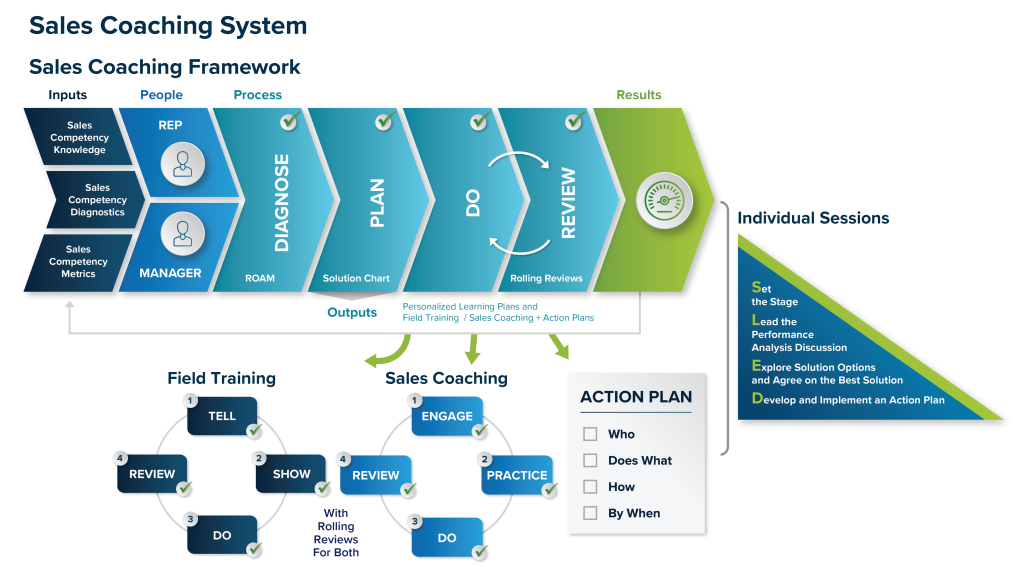
This is the full Sales Coaching System. The framework in the middle consists of Inputs, People, a four-stage Coaching Process, Outputs, three models (SLED, Field Training, and Sales Coaching), and a basic Action Plan.
- WATCH A WALKTHROUGH OF THE FRAMEWORK: Walkthrough of The Sales Coaching System (Framework, Process, and Models)
What makes this approach different? Great question.
- It’s purposeful and planned.
- It engages the seller in their own growth and development, until they own it themselves and the manager becomes the guide.
- It ensures the right solution (training, coaching, feedback, or something else entirely) is applied to address the root-case problem.
- It provides real clarity of expectations and ensures good communication.
This type of behavioral-based, developmental skills coaching occurs over time and repeats in an endless loop. It creates a culture of coaching and a cadence of continuous improvement.
Now, let’s look at the other three types of sales coaching:
- Strategic Sales Coaching
- Tactical Sales Coaching
- Opportunistic Sales Coaching
Strategic Sales Coaching

Strategic sales coaching focuses on the bigger picture. This includes helping salespeople understand market dynamics, customer personas, and the overall sales strategy. This type of coaching is essential for aligning the sales team’s efforts with the company’s long-term goals. It involves guiding reps on how to approach their territories, prioritize their accounts, and develop strategic plans to maximize growth. It tends to be done periodically, as opposed to the daily or weekly coaching that managers do.
- EXAMPLE: How to approach a territory to achieve optimal growth this quarter.
Key Elements of Strategic Sales Coaching:
- Market Analysis: Understanding market trends and customer needs.
- Account Planning: Developing detailed plans for key accounts.
- Goal Setting: Aligning individual and team goals with organizational objectives.
- Resource Allocation: Ensuring the right resources are available to support strategic initiatives.
Tactical Sales Coaching

Tactical sales coaching dives into the specifics of the sales process and sales methodology, focusing on the “how-to” aspects. This type of coaching is about equipping sales reps with the skills they need to execute their strategies effectively. It often involves role-playing, reviewing sales calls, and providing immediate training and/or feedback on specific sales activities. Tactical coaching tends to occur frequently. It is often a result of something seen opportunistically but is sometimes done more purposefully.
- EXAMPLE: How to prepare and execute an upcoming key meeting with a prospect to ensure success and move the deal forward.
Key Elements of Tactical Sales Coaching:
- Skill Development: Enhancing specific sales skills (sales methodology).
- Process Optimization: Streamlining the sales process for efficiency.
- Real-Time Feedback: Providing immediate, actionable training, coaching, and/or feedback on sales activities.
- Performance Metrics: Tracking and analyzing performance data to identify areas for improvement.
Opportunistic Sales Coaching

Opportunistic sales coaching occurs in the moment, often triggered by an observed behavior or a specific situation. This type of coaching is less structured but highly valuable for addressing immediate issues and reinforcing positive behaviors. It can be both strategic and tactical, depending on the context and what was observed, but is most likely tactical.
- EXAMPLE: After observing something her sales rep does during a meeting, a manager initiates a coaching session. She facilitates a discussion, offers feedback, and provides additional training or follow-up coaching as needed.
Key Elements of Opportunistic Sales Coaching:
- In-the-Moment Feedback: Addressing behaviors or situations as they arise.
- Flexibility: Adapting coaching methods to the specific context and needs of the rep.
- Reinforcement: Reinforcing positive behaviors and correcting negative ones on the spot.
- Quick Wins: Focusing on immediate improvements that can have a quick impact on performance.
How Developmental Coaching Can Support the Others
Strategic
The SLED model can be used as a 4-step blueprint for any coaching meeting:
- Set the Stage (expectations, purpose, agenda, outcomes, process, and timing)
- Lead the Performance Analysis Discussion
- Explore Solution Options and Select the Best One
- Develop and Implement an Action Plan
When exploring solution options, the Solution Chart is helpful for determining whether training is needed, whether coaching is appropriate, whether feedback is all that’s needed, or whether some other solution is best.
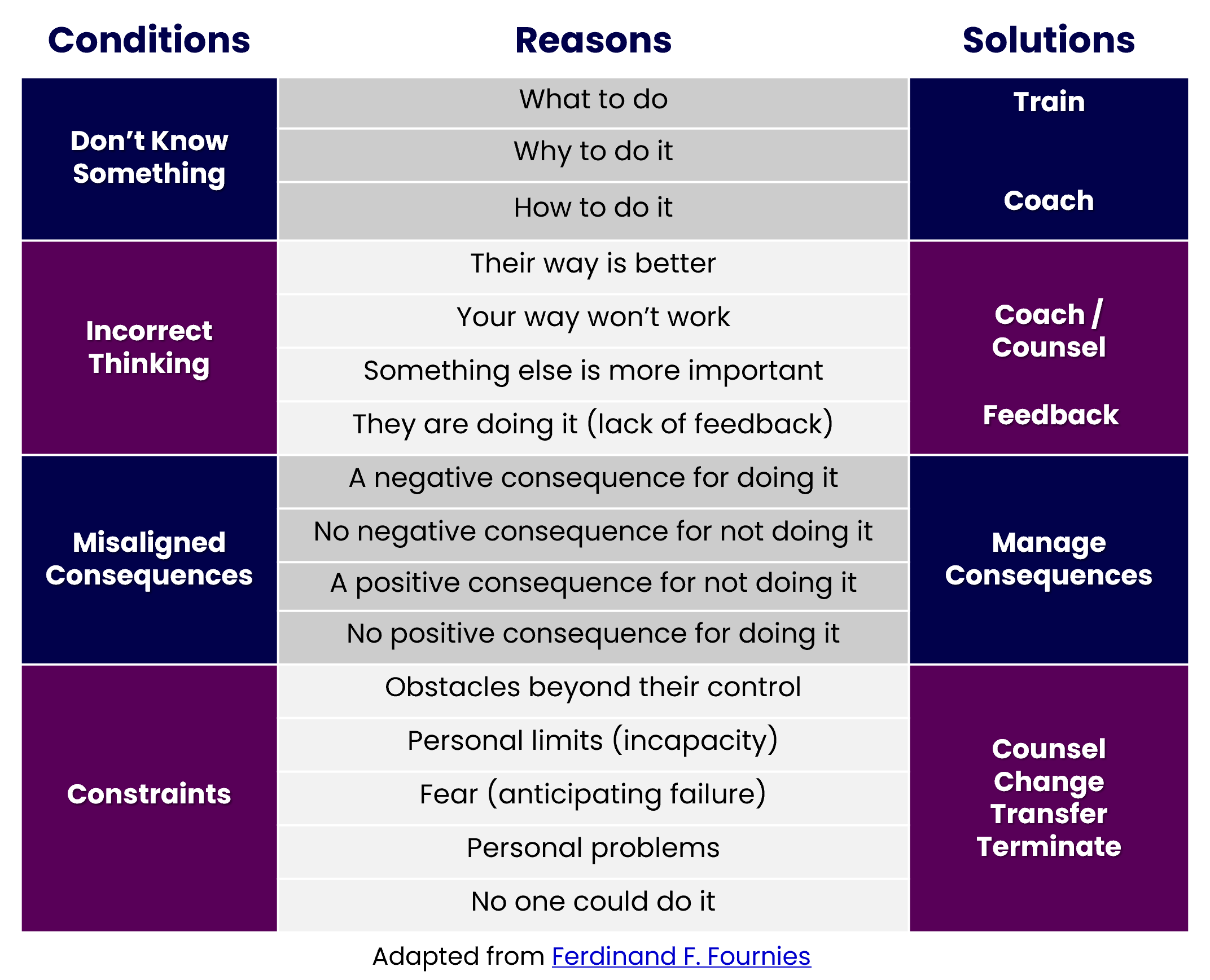
If training or coaching are best, the models from the system can be pulled into SLED where appropriate.

Tactical
As above, SLED, the Solution Chart, and the Field Training or Sales Coaching models can be applied as appropriate. For working on a tactical issue, or before that, identifying one to work on, the ROAM model may also be helpful.
ROAM
- Compare Results vs. Objectives to identify an area of shortfall to explore further.
- Explore Activities + Methodology. When the shortfall is important enough to address, review the Activities being performed (what is being done, with whom, how often, and as appropriate, when and where) and the Methodology (sales methodology) being used, or quality of the activities being performed.
Opportunistic
With Opportunistic Sales Coaching, a manager spots an area for improvement through observation. However, what you see in just one instance could be an exception rather than the salesperson’s usual behavior or skill level. Before giving feedback or deciding that training or coaching is needed, it’s important to have a discussion to understand whether the behavior is part of a consistent pattern or just a one-time occurrence.
Start with SLED and some sort of validation and discussion. Based on what you learn, the Solution Chart may be helpful, as will the appropriate training or coaching models.
In these cases, it’s better to start with assuming that Sales Coaching is required and start with Engage (a two-way discussion). If you learn along the way that there is a gap in knowing what, why, and/or how to do something (or how to do it in a way that will get results and meet your expectations), then you can shift to the more directive Field Training model.
Closing Thoughts
Sales coaching, when done effectively, can be a game-changer for any organization. By understanding and implementing the different types of coaching—behavioral-based developmental, strategic, tactical, and opportunistic—you can create a robust coaching culture that drives continuous improvement and elevates sales performance.
Remember, the key to successful coaching lies in its consistency and intentionality. Whether you’re guiding your team through strategic planning, honing their tactical skills, seizing opportunistic moments for feedback, or targeting key skills to close competency gaps, each type of coaching plays a vital role in your overall strategy.
As you integrate these coaching methods into your routine, keep the focus on long-term development and continuous learning. Thank you for joining me in this exploration of sales coaching. Until next time, keep striving for excellence and happy coaching!
Resources
- COURSE: Sales Coaching Excellence Course
- VIDEO OVERVIEW OF THE COURSE: Sales Coaching Excellence – Training Program Trailer
- VIDEO OVERVIEW OF THE SALES COACHING SYSTEM: Walkthrough of The Sales Coaching System (Framework, Process, and Models)
- You can view Mike’s original post here.

Previous
Next