

Surviving and Optimizing the Modern B2B Complex Sale

Today, I’m going to share how to survive and optimize the modern B2B complex sale. I’ll share what those hard-working, smart-working professionals on the far-right side of the sales effectiveness bell curve do to get the exceptional results that you want, too.
Let’s dig in.
Introduction: Hope Is Not a Sales Strategy
Let’s skip the sugar-coating: Managing the complex B2B sales is getting harder. Buying teams are growing. Approval chains are tightening. Approvers with veto power lurk behind the scenes. Economic pressure is everywhere. And let’s be honest–most sales organizations are still trying to win tomorrow’s deals with yesterday’s thinking.
What used to work doesn’t anymore. Relationships are still important, but “relationship selling” alone won’t cut it. Generic decks and pitch-first approaches get ignored or blocked. And buyer journeys? They’re rarely linear (but can be managed). So, if you’re a CEO, CRO, or sales/revenue enablement or sales/revenue operations leader hoping for predictable growth without serious operational alignment–good luck. Hope isn’t an effective sales strategy. Systems are.
This article isn’t a theoretical deep dive. It’s a field guide for understanding and mastering today’s complex sales landscape – and arming your revenue engine to win in it.
The Reality of Modern Complex Sales
It’s Not a Deal – It’s a 3D Chess Game
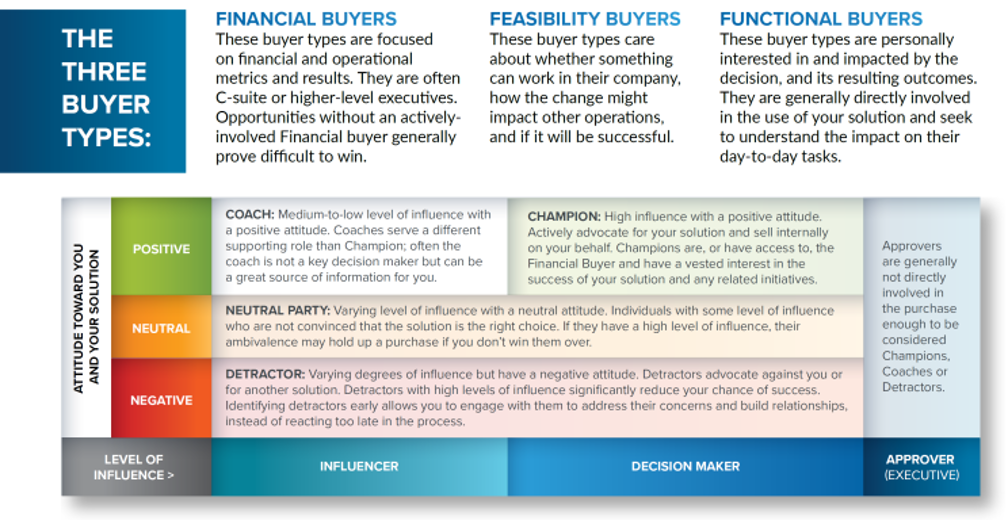
Selling to one person is almost a fairy tale these days. Although that still varies by vertical industry and who buys what you sell, most B2B deals now require navigating a buying committee filled with influencers, detractors, hidden saboteurs, and the occasionally disengaged senior executive with veto power. Success hinges on finding, engaging, and mapping every stakeholder – and aligning your value messaging to what matters most to each of them.
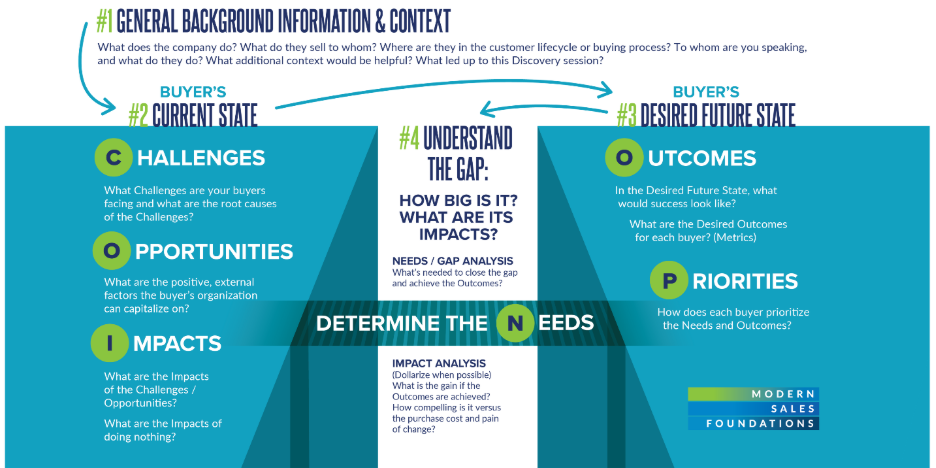
That’s where COIN-OP comes in. To break through, your sellers must understand each stakeholder’s perspective on:
The Current State
- Challenges
- Opportunities
- Impacts
The Bridge (What’s needed to close the gap between states)
- Needs
The Desired Future State
- Outcomes
- Priorities
The Situation Assessment Framework with COIN-OP helps reps shift from pitching products to solving real business problems. And in the framework, the COI is the Current State situation, the OP is the Desired Future State, and the N is what’s needed to bridge the gap (gap analysis). The seller can also analyze the difference between the Impacts and Outcomes (aka, an impact analysis), to further develop a compelling business case and a strong need for change (and if appropriate in your business, the beginnings of an ROI projection).
It’s not always about who signs the contract (although they’re important) – it’s also about who shapes the decision. In some cases, that influence may be hidden in the white space of the org chart. Your job is to test reality and dig deep enough to surface it – all while maintaining, deepening, and not damaging the relationships you’ve established so far. The hard-charging, bull-in-the-China-shop salesperson of the past has no chance of survival in this environment.
And let’s not forget the impact of politics. Many deals are derailed by internal conflict, risk aversion (FOMU or fear of messing up), or a lack of consensus. Selling effectively means coaching your Champions (and Coaches) through their own internal sales process – arming them with the right content, business case, and rationale to position internally as your advocate, and move things forward.
Navigating Complexity with Clarity
Navigating complex deals means guiding buyers through ambiguity. Most organizations aren’t aligned internally, so helping them build consensus becomes part of the seller’s job. That’s where enablement leaders and managers/coaches need to train reps to work both horizontally and vertically within accounts. Influence isn’t always obvious. Sometimes it’s the admin who owns the project plan, or the department lead who’s respected by everyone but has no title or power.
Teach your sellers to recognize hidden influencers, identify the internal buying process (formal or not), and drive momentum through micro-commitments. Complex deals are won by those who create clarity for their buyers–internally and externally.
Cross-Functional or Crossed Wires?
Internal misalignment kills deals faster than your competitors do. If your marketing, sales, enablement, product, and customer success teams can’t align around a shared definition of “what good looks like,” you’re making it harder for buyers to say yes.
Sales enablement can fix that – but only if you treat it like a system, not a department. The Sales Enablement Charter in my Building Blocks of Sales Enablement framework aligns stakeholders, defines roles, and operationalizes enablement across the org. Done right, it’s your blueprint for collaboration, not chaos.
When every team sings from the same sheet of music (or rows the boat in the same direction, if you prefer), buyers feel it. Your message becomes clearer. Your value is easier to articulate. Your credibility goes up.
Accountability Isn’t a Dashboard
Sales dashboards are great – until they lull you into thinking you’ve got accountability handled. Real accountability means inspecting what matters: buyer progression, exit criteria satisfaction, rep activity tied to outcomes, and systemic gaps.
Run Building Blocks gap analyses regularly. Where are your breakdowns – in messaging, competencies, content, process, methodology? If you’re not identifying and fixing these gaps, you’re not enabling performance – you’re enabling status quo.
And here’s the kicker: accountability starts at the top. If senior leaders aren’t reinforcing systems, inspecting pipelines with intent, and holding teams to performance standards, your culture will default to mediocrity.
Accountability isn’t about micromanaging reps – it’s about empowering them to perform consistently. That means removing friction, defining expectations clearly, and coaching to specific behaviors and outcomes.
Sales Enablement: The Operating System for Sales Performance

Stop Treating Training as a Fix-All
Training matters – in fact, it’s a big deal. But it’s also not a silver bullet. You don’t fix broken systems with better courses or workshops. Sales enablement isn’t about content dumps and certification scores. It’s about orchestrating the strategy, process, content, coaching, and tech that allow reps to execute. That said, it should be about executing what was trained, so there is a needle and thread running through everything, connecting it to the process and methodology you want to run.
That’s why I developed The Building Blocks of Sales Enablement in the first place. It’s not a menu. It’s an interlocking system. It ensures you:
- Align your org around buyer needs.
- Equip managers to coach (not just report).
- Give reps the training, content, tools, and skills to sell the way buyers want to buy.
- Build content that maps to the buying journey – not your org chart.
Want to dig deeper? Check out the book here.
Operational Discipline, Not Random Acts
Start by codifying your sales methodology – one unified, buyer-centric way to sell, across prospecting, opportunity management, and account management. Then embed it in onboarding, coaching, deal reviews, and CRM.
Random acts of content? Random acts of selling? They should end right here, right now.
And while you’re at it, define and operationalize exit criteria for each major persona in every process stage. Your CRM isn’t a suggestion box – it should reflect real buyer behavior, not wishful thinking.

Buying process exit criteria are the buyer’s side of the story. If a seller hasn’t met the buyers’ requirements to move forward (and each stakeholder may have unique exit criteria), it doesn’t belong in the next stage. Period. Enforcing this standard adds discipline to your forecasts and integrity to your pipeline. Stop guessing. Start having authentic conversations with buyers to uncover and clarify exit criteria per buyer per stage, deliver what’s needed, and then actually confirm that their exit criteria are satisfied. Harder? Yes. Worth it? The higher win rates tell the story. And separately, as pictured above, buyer engagement content should be developed around the common exit criteria (and remain customizable for when the criteria are different).
Force Field Analysis: Change with Eyes Wide Open

Change is hard. Especially collective behavioral change in organizations. Always has been. But you can reduce friction using a Force Field Analysis to identify driving and restraining forces before rolling out new processes or tech. (Force Field Analysis has SO many uses… Building Blocks implementations, account planning, anything that involves change.)
What’s in the way? Habits, incentives, silos, tech bloat? Identify it. Plan around it. Get buy-in from those affected. And do it before launching your next big initiative.
It’s not just about managing change – it’s about leading it.
Coaching, Systems, and Performance
Coaching Isn’t Optional – It’s a Force Multiplier

If your sales managers aren’t coaching, your enablement strategy is broken, and your GTM consistency isn’t far behind. Period. Great managers are force multipliers. But too often, they’re stuck playing spreadsheet sheriff instead of developing people. Or they are firing off rushed, directive feedback, while thinking they’re coaching (which they’re not).
That’s why I created Sales Coaching Excellence. It’s a full coaching system and training program that turns managers into high-impact coaches – so reps get better at what matters, faster. It includes a framework with:
- Inputs
- People
- Process
- Tools
- Outputs
- Models…
… all designed based on yours of analyzing what top-performing managers do differently.
You can learn more here or at the link above.
Effective coaching drives behavior change – and behavior change drives results. That’s the math. (It’s counterintuitive and as ironic as an Alanis Morissette song, but you can’t change results by focusing on results.) But coaching only makes a bottom-line impact if it’s data-driven, purposeful, consistent, focused, and reinforced by leadership. It requires a cadence and a coaching culture to drive continuous improvement. And the top-down support isn’t optional. What gets measured gets done, but what gets asked about gets attention and focus.
Sales Systems Are the Connective Tissue
Let’s clear something up: Sales systems are not your CRM. They’re not enablement software or other tools. They are systems, as in systems thinking, not technology. They’re the collection of operational processes that drive performance – from hiring and onboarding, training, sales readiness, GTM management, territory planning, opportunity management, coaching, sales management, and more.
High-performing companies embed these into daily operations – not annual planning meetings. Sales effectiveness is never an event – it’s a system.
Use a systems-thinking lens to examine how these elements interact. Where is friction happening? Where are handoffs breaking down? When you fix systems, performance improves naturally.
“Pit a good performer against a bad system, and the system wins almost every time.”
Geary Rummler
Ramp with Purpose
Onboarding isn’t about culture decks, buddy programs, or boot camps. It’s about shortening the time to quota. Fast. That means:
- Scenario-based training that mirrors the sales process/methodology from left to right.
- Embedded practice and feedback loops.
- Performance milestones and progress checkpoints tied to buyer-facing activity and the outcomes.
Build onboarding around what reps will actually do – not what you hope they’ll remember. Track progress relentlessly. Use metrics like time-to-first-meeting, time-to-opportunity, and time-to-revenue, not just course completions.
Add ongoing enablement into the mix. Ramp doesn’t end when onboarding does – it evolves into mastery through reinforcement, coaching, and performance support.
Content & Buyer Acumen: Sales Fuel That Works
Know the Buyer Better Than They Know Themselves
Effective enablement starts with Buyer Acumen. If your sales teams don’t understand:
- The buyer’s COIN-OP.
- Their internal process.
- What drives their decisions.
…they’re guessing. And guessing doesn’t close deals.
Use buyer journey maps, defined personas, and stage-specific messaging that helps buyers progress, not just understand.
Leverage tools like ROAM (Results vs. Objectives, Activity + Methodology) to troubleshoot deals and guide conversations. Ensure qualification with FACT+NASA. It aligns your reps’ efforts to the buyer’s business case and urgency–and gives leadership visibility into real deal health.
Retire Random Acts of Content
Your content must:
- Be co-created with sales, enablement, and marketing (specifically with product marketing if you have it)
- Address buyer COIN-OP, not just product features.
- Support consensus-building internally with your prospects.
If it doesn’t help the buyer say yes – or help their team say yes – it’s noise.
Great content doesn’t just explain your solution. It creates momentum inside the buying team. It answers, “Why now?” and “Why us?” in a way that each stakeholder can understand and support.
Want to dive into value messaging that aligns to buyer drivers? See this guide: How to Radically Improve B2B Sales Win Rates.
Technology: Use It, Don’t Worship It
Process Before Platform
Technology is a multiplier–but only after your process is solid. Don’t automate chaos.
Your CRM should support:
- Clean, actionable pipeline views.
- Accurate stage progression based on exit criteria.
- Embedded methodology steps–not just data entry.
Use analytics to surface friction, improve coaching, and validate improvements. Look for a correlation between activity and outcomes. Are your best reps doing something differently? What behaviors are creating the lift?
Don’t treat tech as strategy. Use it to scale what already works.
Measure What Matters – And Adapt Relentlessly
Outcomes Over Optics
You don’t need more dashboards–you need better decisions.
Measure:
- Opportunity conversion rates.
- Sales velocity.
- Win rates.
- Ramp time.
- Retention and expansion.
Regularly review with leadership. Act on the data. Then measure again.
Create a culture of evidence-based improvement. When you measure the right things–and actually use the data – you get better faster. You eliminate wasted effort. You create repeatability.
Leadership: This Starts and Ends with You
Enablement is not a department initiative; it’s a business imperative. If it’s not tied to revenue outcomes, it’s not enablement.
Senior leaders must:
- Sponsor enablement efforts.
- Hold teams accountable to performance systems.
- Expect and inspect execution.
Want to build a high-performing team? Don’t delegate that responsibility away. Own it. Model it. Lead it.
Closing Thoughts: Time to Get Serious
The complex sales landscape isn’t slowing down. It’s only getting more… well, complex. If you want to win in this environment, you can’t wing it with hope, hustle, or heroics. You need systems. You need a strategy. You need execution at scale.
Use The Building Blocks of Sales Enablement to diagnose and fix what’s broken. Use Modern Sales Foundations to teach reps how to sell the way buyers buy. Use Sales Coaching Excellence to equip managers to lead and develop their teams. Use Sales Management Foundations to prepare your next generation of frontline leaders.
For more information about these programs and frameworks, visit:
- The Modern Sales Foundations website (it’s our training brand as well as the name of our flagship program)
- The Building Blocks of Sales Enablement book, the eBook on developing an enablement plan, and the course
For Sales Management Foundations, which is in beta, see:
- This overview deck: https://bit.ly/SMF-Overview
- Info on the beta program: https://bit.ly/SMF-BetaProgram
If you’re ready to lead, coach, and enable in a way that drives measurable performance – this is your blueprint.
Let’s stop guessing and start winning.
This post was originally published as a LinkedIn newsletter, which you can find here.

Previous