

How to Run Effective One-on-Ones with Your Sales Reps

Introduction
If you’re a CEO or Head of Sales, you already know this: frontline sales managers are the linchpin of your revenue engine. They’re the ones who translate strategy into execution, culture into behavior, and potential into performance.
But here’s the kicker: most managers spend far too little time coaching their reps. And when they do, they often wing it with opportunistic coaching. One-on-one meetings are one of the most underutilized levers for sales performance. Done right, they’re not just check-ins. They’re high-impact coaching sessions, strategic deal reviews, and trust-building conversations rolled into one. Done wrong, they’re glorified status updates that waste time and erode morale. Let’s dig in.

The Strategic Value of One-on-Ones
In our Sales Coaching Excellence course, we emphasize that sales managers must shift from being reactive firefighters to proactive performance coaches.
One-on-ones, done well, can be one of the key vehicles to drive that shift.
- Research from the Sales Management Association found that companies where managers spent more time coaching saw 20% higher quota attainment.
- And a study by CSO Insights revealed that formal coaching processes correlate with win rates that are 28% higher than those without them.
These results are significant, yet oddly, often ignored.
But it’s not just about metrics. One-on-ones are also where culture is reinforced, expectations are clarified, and reps feel seen, heard, and supported. They’re where you build the kind of psychological safety and relationship that drives discretionary effort—that extra mile reps go when they feel understood, respected, supported, and challenged.
The Mindset Shift: From Status Updates to Development Dialogues
Let’s be clear: this isn’t a weekly interrogation. It’s a collaborative conversation owned by the rep and facilitated by the manager. In our Sales Coaching Excellence program, we often say the rep owns their development, and the manager becomes their guide or Sherpa (if you like mountain climbing metaphors).
This growth-mindset shift changes everything. It moves the manager from taskmaster to talent developer. It empowers reps to take ownership of their growth. And it creates a rhythm of accountability and continuous improvement that compounds over time.
Before the Meeting: Preparation Is Everything
A great one-on-one starts before anyone opens their mouth. (Just like sales call planning before a meeting with a client.) Both the rep and manager should prepare using a shared document that includes the agenda, performance metrics, deal notes, and coaching opportunities.
Salesperson’s Preparation
Update performance metrics: Reps should come in knowing their KPIs: activity levels, conversion rates, pipeline coverage, and so on.
Add agenda items: Reps should drive the agenda by listing challenges, blockers, and deals they want to discuss.
Nominate a call for review: For coaching-focused sessions, reps can suggest a recorded call or refer to a meeting the manager observed for joint analysis. They can also ask for support to prepare for an upcoming high-stakes client meeting.
Use ROAM for self-diagnosis: Reps can apply the ROAM model on themselves to identify root causes of performance gaps:
- Results vs. Objectives: Where are the gaps that matter?
- Activities: Are the right tasks being done, with the right people, in the right amounts?
Methodology: How well are those tasks being executed (the use of your sales methodology)?
Manager’s Preparation
Review performance data: Look at trends, not just snapshots. What’s improving? What’s slipping? Where are the biggest gaps? What recurring patterns do you notice?
Check previous notes: Follow up on earlier commitments. This shows you’re paying attention and fosters accountability.
Identify coaching moments: Spot opportunities to reinforce good behavior or address skill gaps that will lift results.
Apply ROAM diagnostically: Use ROAM to assess the rep’s developmental needs and prepare targeted questions or support.
As you can see, when both parties prepare, it creates an opportunity to compare notes rather than react in the moment. You can conduct a “Let’s compare notes” discussion and allow the rep to go first.
During the Meeting: One Possible Agenda
Here’s a sample agenda. It’s flexible but structured enough to drive results.
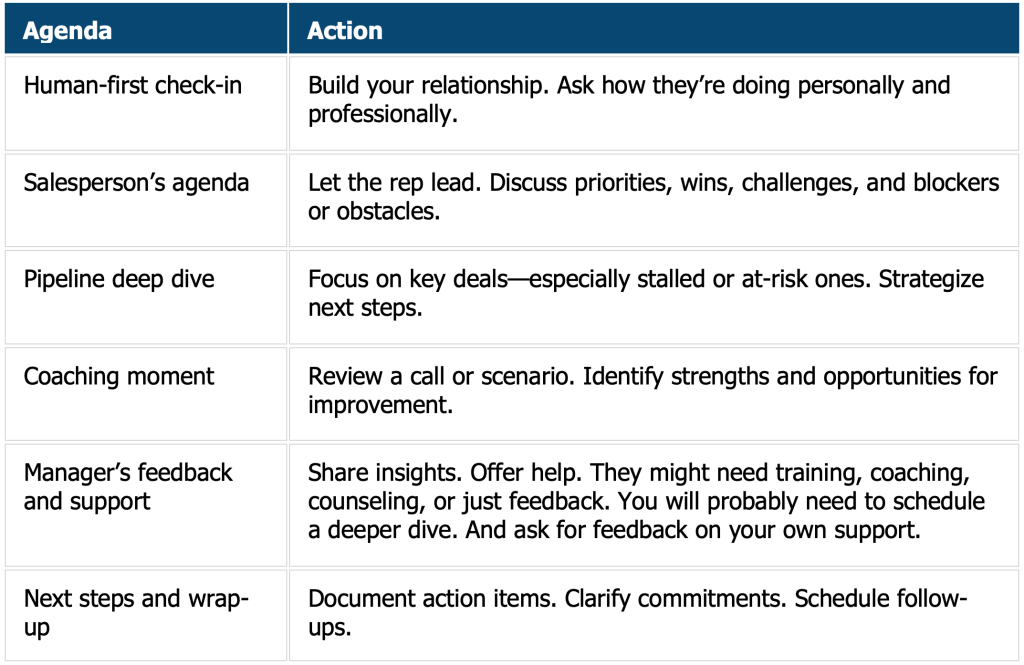
Use SLED to Structure Coaching Moments (or the Whole Meeting)

While that agenda works well, you can also use SLED to structure the entire one-on-one or just the coaching segment. SLED stands for:
- Set the Stage
- Lead the Performance Analysis Discussion
- Explore Solution Options and Agree on the Best One
- Develop and Implement an Action Plan
Let’s break it down.
Set the Stage
Start with a “POP Value Check:”
- Purpose: Why are we meeting?
- Objectives: What do we want to accomplish?
- Plan: How will we do that?
- Value: What’s in it for the rep?
- Check: Is there anything else they hoped to cover?
Note: If it’s your first time using this method for one-on-ones, extend this step to explain the new approach. Reps may be apprehensive or skeptical. Build psychological safety by sharing your intent to support their growth and career development. Over time, walk your talk to earn their trust.
Lead the Performance Analysis Discussion
Use our ROAM root-cause diagnostic model and available inputs to analyze where to spend your valuable coaching time. Ask reps to come prepared with their own analysis. Start with their perspective, then share yours, and align on where to focus.
One caveat: We all have blind spots and cognitive biases. One of the most common—illusory superiority—is very real. If your seller has general low self-awareness or this specific cognitive bias, you may have to work a bit harder to help them see gaps or where to improve. This is a separate topic beyond the scope of this article, but if you run into this, use real examples as much as possible. As with a prospect who is expressing skepticism, you will need to provide proof first.
To get to root causes:
- Compare Results vs. Objectives to identify gaps worth addressing.
- Examine Activities: What are they doing, with whom, how much, when/where?
- Assess Methodology: How and how well are they executing those activities with your chosen sales methodologies?
Note: This may require observation or call recording reviews to complete the analysis before moving to coaching. To be clear, I’m not suggesting intentional subterfuge on the rep’s part, but due to varying levels of self-awareness, there is often a difference between what people say they did, and what actually happened.
Explore Solution Options and Agree on the Best Solution
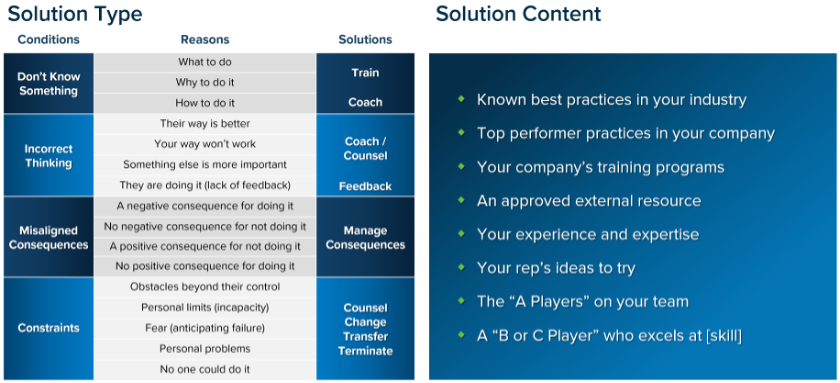
Use the above Solutions Chart (on the left, adapted from Ferdinand F. Fournies) to determine whether the best solution (the solution type) is:
- Training
- Coaching
- Counseling (coaching applied to mindset or self-limiting beliefs)
- Feedback
- Or something else entirely, that those things won’t fix
Note: Also identify the solution content (on the right in the above image), meaning the best practices or competencies needed to improve the skill and get the desired results. Delivering the right solution may take more time than a one-on-one allows. This is when you HAM-BAM or “Have a Meeting, Book a Meeting,” to dive deeper at a later time.
Develop and Implement an Action Plan
If you have time during the meeting, or at the rescheduled meeting, apply the appropriate model (Field Training or Sales Coaching) to improve the skill. After the role play/practice, have your rep develop an action plan. You can guide them, as needed, but they should own it.
Before ending, schedule the first Rolling Review session to ensure follow-through. Then, they implement the plan.
To dig deeper into SLED, see: How to SLED Through a Coaching Session
To read more about the Field Training and Sales Coaching models we teach, see: 4 Coaching Models That Sales Managers Need to Master
Delivering Feedback with SOIL
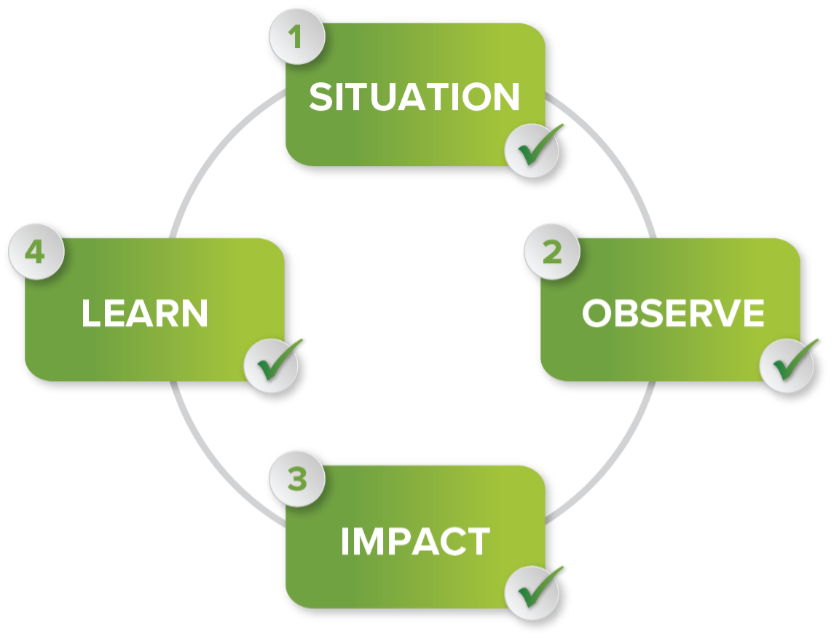
When it’s time to give feedback, use the SOIL model.
There are two foundational guidelines:
- Seek Permission First: Always ask before offering feedback.
- Be Specific: Vague feedback isn’t helpful. Be kind, but clear and direct. SOIL radically improves the likelihood that feedback will be heard, understood, and adopted.
Then use the model:
- Situation: Describe the context and gain agreement.
- Observe: Share what you saw or heard and confirm your rep’s perspective.
- Impact: Explain the effect on others or outcomes and check for understanding.
- Learn: Offer advice or recommendations on what your rep could do differently to get a better outcome.
Note: Each step should include an Understanding Check to confirm alignment. If the rep resists the feedback, you may need to shift to Sales Counseling. For significant feedback, have them document an action plan and implement it.
To dig deeper into SOIL, see: Get Grounded with SOIL to Deliver Better Feedback
Best Practices for High-Impact One-on-Ones
Let’s go beyond the basics. Here are some best practices that separate great managers from average ones.
1. The Rep Owns the Agenda
This isn’t just a nice-to-have, it’s a powerful shift. When reps drive the conversation, they engage more deeply. They’re more likely to surface real issues and take ownership of solutions.
2. Avoid Cancellations Like the Plague
One-on-ones are sacred. Canceling them sends the message that coaching is optional. If you must postpone, reschedule immediately—and make it the first thing back on the calendar.
3. Listen More Than You Talk
Active listening is a superpower. It builds trust, uncovers root causes, and makes reps feel valued. If you’re talking more than 50% of the time, you’re probably missing something important. Use the ACC model (acknowledge, clarify, and confirm) to ensure deep understanding.
4. Separate Coaching from Performance Management
Yes, you’ll discuss metrics. Yes, you’ll discuss what, why, and how to improve things, especially during the pipeline reviews and coaching. But maintain a focus on development, not judgment. Save performance management for quarterly reviews or separate meetings. If performance warrants correct action or progressive discipline, work through your manager and HR and handle that separately.
5. Document Everything and Track Performance
Use a shared document to track progress, commitments, and growth. This creates a living record that helps with coaching, performance improvement, and ongoing development.
Common Pitfalls to Avoid
Even well-intentioned and experienced managers occasionally fall into common traps. Here are a few to sidestep:
- Turning the meeting into a status update
- Dominating the conversation
- Skipping coaching moments
- Focusing only on deals
- Avoiding tough conversations (meaning don’t avoid them, and do them well)
Note: Use SLED to structure, ROAM to diagnose, train, or coach as needed, and use SOIL to deliver feedback, and you’ll avoid these pitfalls.
Closing Thoughts: From Meetings to Momentum
When done right, one-on-ones become a flywheel for performance. They create momentum, build trust, and drive continuous improvement. They’re not just meetings; they’re culture in action.
If you’re a CEO or Head of Sales, ask yourself: Are your managers equipped to run these effectively? Do they have the frameworks, skills, and mindset to coach—not just manage? Are one-on-one meetings run consistently across your sales force?
This is where what we teach in Sales Coaching Excellence and Sales Management Foundations comes in. We teach managers how to lead these conversations with confidence, consistency, and impact. And we do it in a way that’s practical, scalable, and rooted in real-world sales environments.
Resources
Related Articles and Blog Posts:
Related Training Courses:
- Sales Management Foundations: See this Overview and The Beta Program information

Previous
Next