

How to Get Your Sales Training to Stick and Produce an ROI

It’s not impossible to get your sales training to stick, produce results, and even deliver a return on your investment (ROI). There’s often a difference between simple and easy, but it’s not really that difficult either. It does take a focused, purposeful approach, follow-through, and some discipline, but the returns are worth it. Multiple studies have shown that companies with high levels of adoption of a formal sales process and methodology far outperform the rest.
Let’s explore how you can maximize your investment in sales training and get it to stick.
Sales Training is a Change Management Project
Treating sales training as a change management project is the key to success. It doesn’t require a large complex framework to accomplish, there are simple models that work. I created a Sales Training System that I modeled after Kurt Lewin’s Unfreeze, Change, Refreeze concept.
The Sales Training System

As you can see in the graphic, I used:
- Prepare for Change
- Guide the Change
- Cement the Change
Let’s look at each in more detail.
Prepare for Change
Content Effectiveness: The content you teach is central to success. You must start by ensuring that your training content will get results in the real world, when used. If you fail here, it doesn’t matter how well you do the rest. Top-performer analysis is a sure-fire way to ensure content effectiveness but you can also purchase methodologies that have been proven-effective (and some, like Modern Sales Foundations, have been built from many top-performer analyses over the course of many years).
Learning Experience: If you want your training to succeed, you must design a great learning experience. There’s an old saying that a hungry dog isn’t deterred from eating by the color of the bowl. Highly motivated learners will learn from even poorly designed training. Unfortunately, beyond these inspired few, the large majority of learners, especially busy and pressured salespeople, will disengage if the learning experience isn’t both relevant and captivating.
I find it fascinating that anyone who knows something about anything feels qualified to develop or deliver training for it. This is one reason there is so much bad training in companies today. If you aren’t an instructional design expert, hire or contract with someone who is an expert in performance-based instructional design, and engage them to create your training, or buy a program that fits your company and has been proven to work. You’ll thank me later.
Manager Readiness: Next, you must engage, enable, and empower your frontline sales managers. These managers are your performance lever for change in any sales force. If the frontline sales managers don’t understand, buy-in, support, reinforce, and coach the skills and behaviors you teach, your program will never succeed. I strongly recommend training your managers first and preparing them to reinforce and coach the program.
Guide the Change
In this section there are five stages that I call “The 5 Stages of Sales Mastery and Behavior Change.” This is a purposeful way to guide your sellers through a process that will improve their skills and results. In over 30 years doing this work, I have never seen a highly successful sales training implementation without these five stages. They are:
Learn
In the training, your sellers acquire the knowledge behind the skill with examples and assessments/tests to validate learning. Role plays and practice should be part of the learning experience to start them on their journey to using the skills. Training managers first and having them attend with their sellers can be an excellent strategy.
Remember
Just because someone learned something, doesn’t mean they’ll remember it. Spaced repetition or bite-sized, drip learning helps people remember concepts and foil the forgetting curve, as does retrieval learning (post-learning question and answer, summarizing what was learned, or teaching the content to others).
Simply having leaders and managers ask how a concept has been used can trigger memory retrieval and reinforce and solidify recall. Even better, have managers run post-training reinforcement sessions (provide a guide to support your managers in doing this), which will add another layer of reinforcement, using the manager who will need to coach to the skills, as well.
Practice
In the training, after the training, in the sessions run by managers, or even in weekly and one-on-one sessions, you and the sellers’ managers should orchestrate as much practice as possible, with feedback loops. Yes, this means role play. It’s important to foster psychological safety with role play, but to not allow people to opt out of practicing.
To go into more detail on effective practice, delve into these three articles and video:
- Sales Leaders: It’s Time to Get Serious About Purposeful Practice & Skill Mastery
- Maximize the Power of Role Play
- The Power of Role Play Reruns! (with video)
Apply
In this stage, you encourage the sellers to apply their newly acquired and practiced skills in the workplace with their buyers and customers. One would this happens naturally, but we know it often doesn’t. There are multiple ways to encourage it, including documenting action plans (setting the expectation), preparation worksheets (and reviewing them in advance), ride-alongs or call-alongs (live observation), and reviewing meeting recordings (and scheduling the review, so the seller knows the skill usage is expected and will be observed and coached). These actions will all support the application of what was learned in training.
Master
Only the top 1-4% of sellers typically achieve true sales mastery on their own. As with the previous four stages, you simply can’t risk not addressing this purposefully.
Mastery requires deliberate practice, self-reflection, feedback, coaching, and time. Having a purposeful plan for continuous improvement is critical to foster high levels of adoption and mastery, for as many sellers as possible. There will always be a bell curve or power law distribution, but with continued and purposeful coaching, you can achieve adoption levels above 75% and even 90% or greater. This is where the greatest performance lift occurs for win rates, quota attainment, and revenue plan attainment. Establishing a sales coaching system with a cadence of continuous improvement is one of the best ways to ensure your sales force will achieve mastery
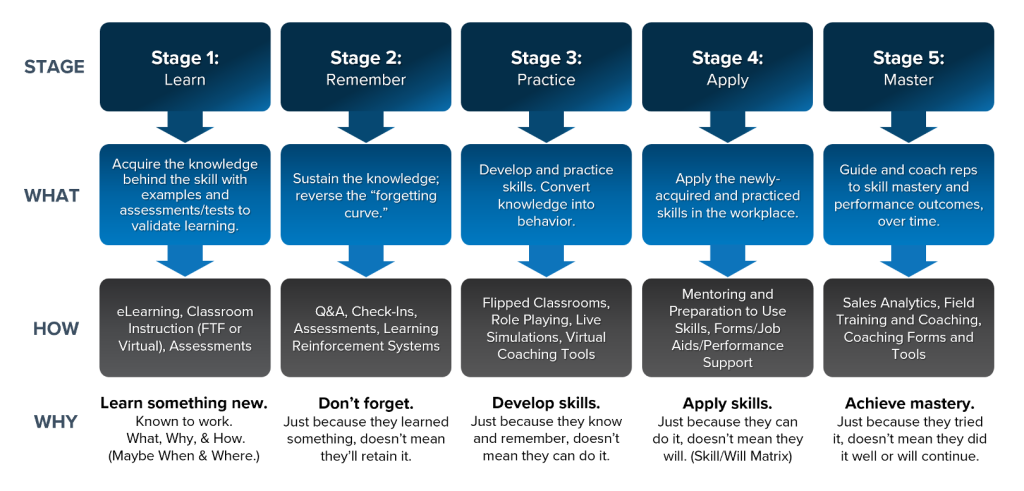
As a summary, this chart of the 5 stages provides some additional detail you may find helpful.
How Sales Tools and Services Can Support the 5 Stages
In the age of sales technology and now, the age of AI, there are many tools and some services that can also support progress through the 5 Stages of Sales Mastery and Behavior Change. This chart lists just some of them that you can consider.
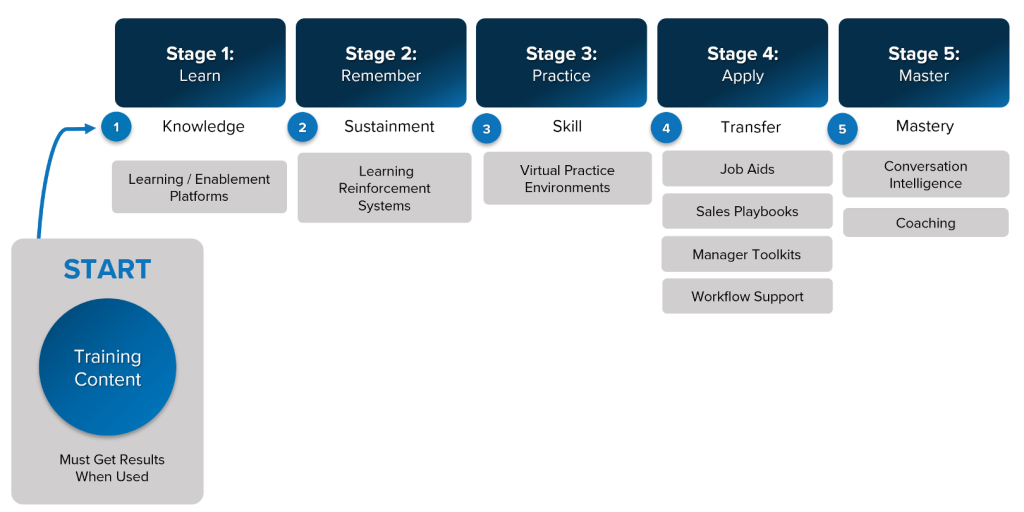
Operationalizing the 5 stages in this way, along with establishing a sales coaching system, is the best way to begin to change the culture and “how we do things around here.”
Cement the Change
Imagine delivering effective training and establishing systems and cadences to support it, to just let it peter out, while the sales force returns to what they were doing previously.
Sounds ridiculous, right? Yet, it happens far too often. Now that you’ve come this far, you need to cement the changes in place.
Metrics and Measures: Get metrics and measures in place to evaluate the leading and lagging indicators of what you’re trying to change. This is very contextual but likely includes measures for both training progress and sales performance progress.
Manage Expectations: Manage to behavior and performance expectations. A sales training report from the Association for Talent Development once reported that 59% of respondents cited the inability to hold sellers accountable to use what they were trained, as the primary reason for sales training failure. Stop and think about that for a moment. That is sheer folly and shows either a stunning lack of top-down support, or the inability of the trainers to select the right content that leaders would support. Since the latter would likely have been stopped before it started, I assume the primary failure is lack of support and accountability. This must be communicated and address in advance, with roles and responsibilities clearly delineated, to avoid this disaster at the end. If you expect adoption, sellers and frontline managers must be held accountable for using what was taught.
Lead the Change: Lead and manage the change until it cements in the culture. While much of this system that I’m sharing is change management, there is more outside of this system that leaders can do. Over-communicate the need and reasons for change, build a guiding coalition and gain stakeholder support, and more. Separately, you must become an expert in guiding organizational change. There are many good books and resources on this topic, and you will never regret developing this expertise.
Closing Thoughts
I hope you have found this article helpful and are walking away with some promising ideas to use and explore further. If you need guidance in implementing a Sales Training System or the 5 Stages, we can help. Or, if you are seeking a sales training program that is built and implemented with this principles, you can explore Modern Sales Foundations. Lastly, if you’d like to train managers to do the type of coaching described here, Sales Coaching Excellence can support that, as well. Whatever ever need, or decide, I wish you the greatest of success in getting your sales training to stick and achieving the returns you hope for.
Struggling to get lasting results from your sales training?
Our 5 Stages to Make Sales Training Stick infographic breaks down a simple process to ensure your team applies what they learn. Click here to download it now!

Previous
Next