

How to Build and Lead a High-Performing Sales Team

Today, we’re diving into a topic that can make or break a sales organization: how to build and lead a high-performing sales team.
This is a big one. It involves hiring, training, coaching, managing, motivating, and leading. It also involves some choices:
Will you lead reactively, with good intentions but little structure?
Or will you build systems that drive performance by design?
And, as organizational leaders, will you prepare your frontline sales managers in advance, or even retroactively? Or will you let them flounder and hopefully figure things out on their own?
This article is for those who choose to prepare their managers, either prior to promotion or shortly after. And especially for CEOs, senior sales leaders, and those in supporting roles like sales/revenue enablement, sales/revenue operations, and sales training… if you’re responsible for enabling frontline managers, this one’s for you.
Let’s get into it.
Hiring: Build the Foundation Right

Salespeople are the lifeblood of every sales organization. As the saying goes:
“Nothing happens until somebody sells something.”
But let’s be honest… just because someone can sell themselves well in an interview doesn’t mean they’ll perform well on the job. Interviews have a low predictive validity, ranging from 15-35% predictive, based on how well they are constructed and executed. You can get better results from a coin flip.
That means hiring managers who only interview candidates are getting it wrong 65% to 85% of the time. It’s no wonder, given the number of cognitive biases involved: wishful thinking, confirmation bias, the halo effect, and more.
Worse, hiring mistakes are incredibly costly, especially for sales. I’ve seen research estimating the cost of a bad hire at 30% to 125% of a seller’s base salary. Add lost pipeline, team disruption, and time lost to recovery, and the numbers climb fast.
This is why I strongly advocate for a structured hiring system. This is a system that uses multiple, complementary selection methods to create a more accurate picture of the candidate and their likelihood to succeed in the role. No single method is sufficient, but together, they work. (Note: While this is my experience, it’s not just my opinion. Using multiple methods of candidate evaluation has been shown to be more effective than using just one method, in multiple studies. If you’d like to read more, see: Designing an Assessment Strategy.
Here’s the framework I recommend for sales hiring systems (also see the image above).
- Define the competencies required for success, meaning their skills and behaviors.
- Define the traits that support success, meaning their mindsets, underlying beliefs, and habits.
- Document the role, including the job description, sourcing strategy, and recruiting ads.
- Use sales-specific, validated assessments, like those from Objective Management Group (OMG). These should be sales specific, statistically validated, customizable, and reviewed by neutral third parties.
- Create a behavioral interviewing system, with structured questions and scoring.
- Use hypothetical questions when behavioral evidence isn’t available.
- Validate skills through role plays, simulations, or job-relevant tasks that are scored.
- Conduct background and reference checks to confirm what’s been shared (whatever ones are approved by your legal team and used by HR).
Depending on your role, you may not control every aspect of this system, but as a sales leader or enablement pro, you should understand and advocate for it. For now, let’s take a closer look at three areas where frontline managers can make an immediate difference.
Behavioral Interviewing: Real Stories, Real Signals
Behavioral interviewing, done well, is still a reliable way to understand how a candidate has performed in situations similar to those they’ll face in your organization.
Use the STAR-L framework to guide your questions:
- Situation: “Tell me about a time when… [insert competency here].”
- Task: What needed to be done?
- Action: What action did they take? What did they do specifically? Not generally, but what actually happened?
- Result: What was the outcome? Did they win the business?
- Learning: What did they take away from the experience?
Behavioral questions often start with “Tell me about a time when…” or “Share an example of when you…” If a candidate responds with philosophies or vague generalities, stop and redirect them to share a specific story. You don’t want them to tell you what they’d do — you want them to tell you a story about what they did.
And when they do share a learning experience, follow up with, “What did you learn from that experience and how have you applied that lesson since?”
This technique alone can elevate an average interviewer, reduce cognitive biases, and dramatically improve hiring decisions.
Hypothetical Interviewing: When You Need to See the Thinking
Sometimes, candidates don’t have relevant stories. This is especially true for college hires, newer reps, or career changers. That’s where well-designed hypothetical questions come in.
These questions begin with, “Imagine you are…” or “What would you do if…” and present realistic scenarios, often based on situations your top performers have navigated.
While not as predictive as behavioral stories, hypotheticals still provide insight into judgment, logic, and professionalism. This gives you an opportunity to compare their thinking to what a top performer did or would do. One caution: if an experienced seller can’t answer several behavioral questions related to the core competencies that are important for your role, that’s a red flag.
Skill Validations: Don’t Just Tell Me, Show Me!
You wouldn’t hire a wedding band without hearing them play. You wouldn’t invest in a stock without reviewing its past performance. Why would you hire a salesperson without seeing how they sell?
Skill validations allow candidates to demonstrate ability in real-world tasks, such as:
- Conducting account research to personalize outreach
- Leaving a compelling voicemail
- Writing a prospecting email based on persona, their problems, and product details
- Running a brief discovery call or qualification exercise
- Creating a meeting plan
These simulations reveal more than conversations ever will. I’ve seen candidates nail interviews but fall apart in a role play. If they can’t do it in a safe environment with you, what happens when they’re in front of your customers?
Training and Coaching to Foster Sales Mastery
Hiring the right people is critical, but it’s only the beginning. To turn potential into performance, you need a talent development system. Preferably, one that includes onboarding, ongoing training, coaching, counseling (coaching applied to mindset), practice, and feedback loops.
This isn’t just about onboarding. It’s about building habits, reinforcing behaviors, and driving continuous improvement. Frontline sales managers play a critical role here, even when enablement and training teams provide resources.
This is another topic that I’ve written extensively about, and for that reason, instead of re-writing things here, I’ll include links to other articles or newsletters for you to peruse as you wish, to gain deeper insights:
- Maximize the Business Impact of Sales Training
- How to Get Business Value from Sales Training
- The Mysteries of Sales Coaching Revealed!
- So, You Want to Train Your Sales Managers to Coach – Now What?
- 4 Coaching Models That Sales Managers Need to Master
Managing: Drive Execution with Discipline

Managing is where strategy meets execution. It’s how you ensure your team operates consistently, stays focused, and delivers results. The above Sales Management System and its embedded Sales Management Operating System (smOS) is the blueprint for sales management success.
Great managers understand the sales process and methodology inside and out, and how they fit within their customer lifecycle. The activities they perform and the meetings they hold help their team perform at their best. Great managers use these activities and meetings, and the best practices for each and the cadences they run to get into a rhythm and reinforce accountability. From CRM usage and pipeline hygiene to deal reviews and team standups, managing well is the engine room of sales performance.
Execution discipline doesn’t happen by accident. It happens when managers reinforce expectations, inspect what they expect, and guide sellers toward behaviors that produce outcomes.
This is another area I’ve covered in detail, so I’ll also include links to other pieces for additional depth:
- Radically Improve Sales Results with a Sales Management Operating System
- How a Sales Management Operating System Can Transform Your Results
- Building Blocks, Close Up! – Spotlight on the Sales Management Operating System (smOS)
Motivating: What Drives Your Team?
Here’s the trap: assuming everyone is motivated the same way you are. Motivation is nuanced. It can be:
- Extrinsic: Driven by rewards, contests, status, or money
- Intrinsic: Driven by personal growth, mastery, or achievement
- Altruistic: Driven by the desire to help others or contribute
People are complex. Most have a mix of motivations, and context matters. What drives someone at work might differ from what drives them elsewhere.
This is where the PAM Orders Power BARS mnemonic helps. It outlines nine core motivators:
- Purpose – Meaningful, impactful work
- Autonomy – Control over goals, tasks, and time
- Mastery – Pride in doing something well
- Order – Structure, systems, and predictability
- Power – Influence over outcomes or decisions
- Belonging – Connection to a team or community
- Achievement – Desire to win or accomplish hard things
- Recognition – Being acknowledged or appreciated
- Safety – Practical security or psychological safety
Want to influence someone more effectively? Align your feedback, rewards, and consequences with what actually matters to them.
That includes how you use consequences. When you need to manage consequences, remember the Four Behavioral Consequences:
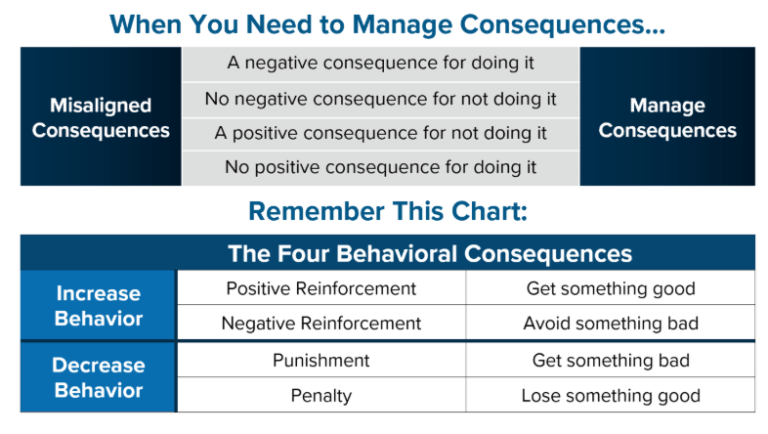
To increase a behavior:
- Use Positive reinforcement: gain something valuable.
- Use Negative reinforcement: avoid something undesirable.
Note: “Negative” reinforcement sounds bad, right? But remember that in this behavioral context, it means to avoid something bad, which is actually a positive thing from the performer’s perspective.
To decrease a behavior:
- Use Punishment: something undesirable happens.
- Use a Penalty: the loss of something valuable.
Use this model wisely. When personal motivators align with feedback and consequences, behavior change becomes far more likely.
Also, remember that emotion follows action, not the other way around. It’s hard to change someone’s mindset or beliefs, and at work, we’re not amateur psychologists. But if you can get to them to behave differently, and get better results, it begins to influence their mindset and beliefs (leading to more of the behavior you want). So, focus on behavior and action, and mindset and beliefs will follow, further reinforcing the change. If you push back on their mindset or beliefs, they will be more likely to resist.
Leading: From Compliance to Discretionary Effort
Leadership is where everything comes together. This is where performance systems meet culture, inspiration, and trust. Managing ensures compliance. Leading unlocks discretionary effort.
Here are five leadership practices that make the difference:
1. Foster a Positive Team Culture
Culture is “how we do things around here” and how people feel while doing them.
Great teams collaborate, share, and support one another. They celebrate progress, not just big wins. They speak openly and feel safe doing so. That psychological safety — where team members can challenge, disagree, and share openly without fear — is a hallmark of high performance.
Create it deliberately.
2. Communicate Openly and with Empathy
No hidden agendas. No guessing games.
Use the ACC model:
- Acknowledge with empathy
- Clarify meaning (“peel the onion” to get to the root cause or deeper meaning)
- Confirm your understanding
And make feedback part of the rhythm. It’s not just an annual event. Role plays, coaching, and praise should be ongoing and actionable.
3. Nurture Meaning and Purpose
Most people want to believe their work matters.
Recognize great work. Express appreciation. Help reps connect their efforts to customer outcomes and broader company goals. This fuels intrinsic motivation and deepens engagement.
Lou Holtz once said that people ask three key questions:
- Can I trust you?
- Do you care about me?
- Are you committed to excellence?
Great leaders help their teams answer “yes” to all three.
4. Set Clear Expectations and Goals
Ambiguity is the enemy of performance.
Whether you use the 5Ws + H approach (Who does What, Why, When, Where, and How,) or SMART goals (Specific, Measurable, Achievable, Relevant, Time-bound), define success in plain terms.
Don’t let your team guess. Show them what good looks like.
5. Train, Coach, and Manage Fairly
Make development universal and equitable.
Some reps may need more of your time due to specific challenges, but everyone deserves access to training and coaching. Use the SOIL model for feedback loops (Situation, Observed behavior, the Impact of that behavior, and the Learning or what you want them to do differently). Be specific, constructive, and consistent.
And don’t confuse coaching with corrective action. Coaching is developmental. Corrective action is reserved for performance or behavioral issues. When the two get blurred, reps start dreading coaching — and that undermines its impact.
Set the tone. Your team is watching.
Closing Thoughts: Build the System. Earn the Performance.
Hiring, training, coaching, managing, motivating, and leading. All of these are essential. But it’s an integration, not an isolated effort, that produces the best result.
When leaders take a structured, purposeful approach, and build these capabilities inside their organizations… performance follows. When they rely on gut instinct and reactive decisions, results suffer.
You need to choose which kind of leader you’ll be. And then you need to choose to develop and foster these mindsets and skill sets in those who you promote into frontline sales manager roles. THAT is how you build and lead a high-performing sales team.
Ready to shape the future of your sales managers?
Check out the new Sales Management Foundations course — now available in a beta format! Designed for new, emerging, or untrained managers, it’s packed with actionable content, expert-led workshops, and real-world assignments.
Learn more about the course or contact us to explore how it can support your team.
You can find Mike’s original newsletter post here.

Previous