

How Single-Threaded Thinking is Hurting Your Enablement Effectiveness

Introduction
Today, I want to talk about how single-threaded thinking is hurting your enablement effectiveness. I’ve written recently about how magic bullets and magical thinking hamper sales effectiveness for sellers, and with recognition of the overlap, it’s no different for us as enablement professionals (or for the sales leaders and CEOs we serve and support).
Yet, I see and hear this kind of thinking all of time. Here’s a list that is far from inclusive but does represent some of the more common ones I’ve seen. I’d love to hear your examples, if you have some. Feel free to chime in, in the comments.
The Magic Bullets of Sales Performance Improvement

- The CRM Solves All: Believing that implementing a Customer Relationship Management (CRM) system will automatically solve all sales tracking and performance issues.
- Social Selling Rules Now: Proponents assume that mastering one or all social media platforms will eliminate the need for traditional prospecting methods such as phone and email. (To be clear, I am a huge fan of layering social approaches as part of an omnichannel strategy to build awareness, interest, and relationship – it’s just not an either/or replacement.)
- We Trained ‘Em, So Now They’ll Sell More: Thinking that a single training event or workshop will transform the entire sales team into top performers, without all the requisite follow-up, reinforcement, coaching, workflow integration, and change management.
- The Ultimate Sales Script: Believing that having that one perfect sales script will guarantee [setting appointments; closing every deal] regardless of the prospect’s unique needs and circumstances.
- Magic Marketing Tool: Some assume that one marketing tool or strategy (like email automation or a sales sequencing tool) will generate all the leads needed without further effort.
- The Ideal Hiring Question: Thinking that one question to ask candidates to make an effective hire will work. I’ve seen so many clickbait articles about “The one question that [Elon Musk, Jeff Bezos, Steve Jobs] asks all candidates to ensure a great hire,” and (at least some) readers seem to believe this nonsense. (This also applies to single-threaded advice about one selection method, such as assessments or behavioral interviewing.)
- The Best Product Feature: Believing that emphasizing one standout product feature will be enough to win over any customer or drive your GTM strategy. (Disclaimer: If you’re the first-to-market or smartest-to-market with some new breakthrough tech like safe human teleportation for travel or 100% foolproof AI cancer detection and best-treatment selection, this one may work for you, for a while. Otherwise, not so much.) There are way more companies relying on Product-Led Sales than there should be.
- That One Thing: That implementing a [new sales process, new sales methodology, new sales tool] will be THE thing that radically improves results.
- I Just Need More Bodies: Continuing to add sales roles/FTEs/bodies because the more you have, the more revenue you produce. This always reminds me of the old joke, “How do you lose money on every deal and stay in business? Volume, volume, volume!”
The Magic Systems of Sales Performance Improvement

You see what I did there, right? To be fair, humor aside, I don’t believe systems are a “magic bullet” either, per se. And the systems would be more like a cartridge of magic bullets, anyway.
“A system is any group of interacting, interrelated, or interdependent parts that form a complex and unified whole with a specific purpose.”
That definition comes from Daniel Kim of the MIT Center for Organizational Learning.
The point is that systems, processes, methodologies, tools, and a combination of the above-mentioned elements – aligned to produce the best-possible results – are what truly fosters an environment that supports high performance.
When I first started with sales performance consulting work, I called the things I was working to align “Performance Levers.”
A Performance Lever is any competency, knowledge, skill, behavior, or condition that must exist to sustain ethical high performance.

Eventually, these performance levers became The Building Blocks of Sales Enablement, which evolved from 2003 to their current version in 2021, when I published my book. The central dozen blocks in blue are the Performance Levers:
To be honest, I didn’t call this “Sales Enablement” back then; the term hadn’t even been coined. In fact, I really debated using the term Sales Enablement with my book publisher in 2021, because the term was already evolving when I was writing the book, and because the blocks covered things beyond what traditional enablement included. But nonetheless, we settled on Sales Enablement.
Behind the blocks, which again are Performance Levers to align, there are the Sales Effectiveness Acumens and the Sales Effectiveness Fundamentals, which I refer to as The Teachable Elements of Sales Effectiveness.

As important as the Blocks and elements of Sales Effectiveness are, they all still need to be implemented effectively to get results. This is where the Sales Systems come into play. By building systems around Sales Hiring, Sales Readiness, Sales Training, Sales Management, and Sales Coaching, you are creating an environment to support the blocks, acumens, and foundations and foster repeatable, replicable, scalable, and predictable execution and performance.
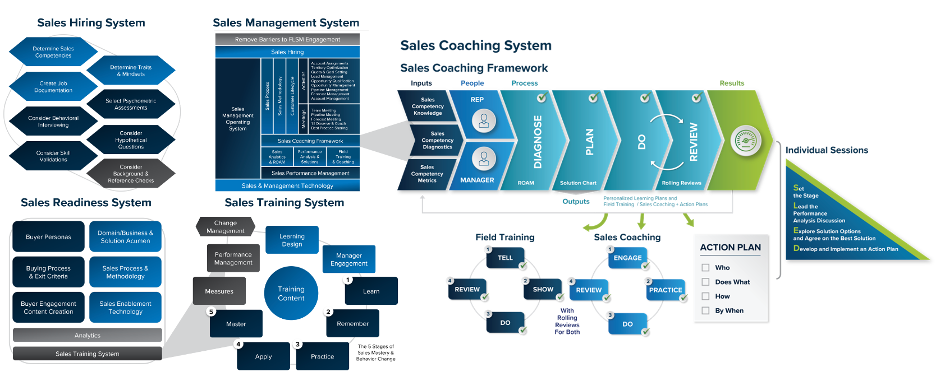
Some of you are probably already familiar with this work, so for you, I’m sorry for the duplication. But even for you, too, I hope this makes the point that it is not a single part of the system, but the alignment and culmination of the parts and systems that makes it all work so well. And when pieces or parts are misaligned or not working well, it’s like an 8-cylinder car running on only 6 cylinders, or an otherwise perfect vehicle with an out of alignment drive shaft.
An Example of Single-threaded Thinking vs. Systems Thinking
As just one example of systems vs. single-threaded thinking, let’s look more closely at the Sales Hiring System.

Now think about those hiring articles that proffer, “The one question that [Elon Musk, Jeff Bezos, Steve Jobs, insert your favorite guru here] asks all candidates to ensure a great hire!”
Sometimes, it is a great question that they ask (assuming, of course, that it applies to the open role). But come on. Hiring is so much bigger and more important than that, and so much more complex. I read recently that Objective Management Group calculated that a failed sales hire could cost up to $800,000! And this true for sales roles because they are like the Olympians of the corporate world or the astronauts of business. They produce the lifeblood revenue that supports business continuation. Or, as the old saying goes, “Nothing happens until somebody sells something!”
Somewhat less ridiculous but still concerning, would be an article recommending only one selection method, such as:
- “How behavioral interviewing can solve your sales hiring problems this year.”
- “Why sales competency assessments are the key to your next great hire.”
Research published in academia, SHRM, and IO Psych journals have all indicated that using multiple selection methods is more effective. They all recommend using a combination of predictors in the hiring process, because no one predictor is perfect.
In my experience, using a validated psychometric assessment based on sales-specific competencies, combined with structured interviewing (both behavioral and hypothetical), with simulations (role plays), and whatever legal background checks can be performed at your company or in your state, will yield radically better hires who perform well on the job.
Even then, each of those elements must be done well and consistently. It’s part of the hiring system, not a one-off focus, such as just doing behavioral interviews. I once saw this total system reduce a 75% first-year new-hire churn rate to 16% in a year.
I’ll stop here since the purpose of this post edition isn’t sales hiring. It’s about the power of systems over single-threaded thinking.
I’m sure it’s not lost on you that this is similar to a single-threaded sales opportunity for a $250K solution with only a business user, versus the same deal that is multi-threaded across the executive team, with a Financial Decision Maker, a Champion, and various business users.
I’m also sure it’s not lost on you that I could come up with examples for every one of the other systems listed above. And guess what? If you want to radically improve sales performance, and I do mean radically, work to get all of these systems in place, along with the best practices in each performance lever (the Building Blocks), and I can promise you that you will be pleased with the results.
Closing Thoughts
Single-threaded thinking can really hurt your enablement effectiveness. Relying on “magic bullets”- like a single CRM system, social selling, or one perfect sales script – promises to solve all sales challenges but falls short.
True sales effectiveness comes from a holistic approach that integrates systems, processes, methodologies, and tools. Think of “Performance Levers” or “Building Blocks of Sales Enablement” as the competencies, knowledge, skills, behaviors, and conditions necessary for sustained high performance. Then, the systems are how you execute.
This is why systems thinking is far superior to single-threaded approaches for sales effectiveness and sales enablement. By implementing robust systems across all aspects of sales enablement, you can achieve radical improvements in sales effectiveness and performance. Moving beyond single-threaded thinking and embracing a systems approach will help you create an environment that supports repeatable, replicable, scalable, and predictable success.
Focus on building these comprehensive systems to drive real, lasting results, and you will be well on your way toward making an impact with enablement!
You can read Mike’s full blog post here.

Previous
Next