

16 Barriers Companies Create That Prevent Sales Managers from Coaching (& How to Fix Them)

Today, I want to talk about how companies (meaning, executives and senior sales leaders) get in their own way by unintentionally creating barriers for frontline sales managers that keep them from fully engaging with their teams to coach and develop them (and improve their performance). I call this the “Sales Prevention Business,” because ultimately, that’s the result.
Introduction
Managers are busy. I get it. But sometimes, they are so busy that they say,
“I don’t have time to coach!”
Busy Sales Managers Everywhere

If sales managers aren’t fully engaging with their teams, diagnosing root causes for performance lags, and training, coaching, counseling, and providing feedback to develop their sellers and guide them to higher performance, one must wonder: “What exactly are they doing???”
Seriously, isn’t that the entire job of a frontline sales manager – to get the best possible performance from their team? And to get into a cadence of continuous improvement?
So, as company leaders, we need to do two things:
- Get Out of Their Way: Ensure we are not inadvertently getting in the way of our frontline sales managers engaging with their teams, and if we are, removing those barriers.
- Develop Sales Coaching Excellence: Ensure our frontline sales managers are well trained on the best practices of sales coaching, including root-cause diagnostic methods, selecting appropriate solutions, and then training, coaching, counseling, and providing feedback (as appropriate), as well as getting into a cadence of coaching and cycle of continuous improvement.
Removing those barriers in Step 1 is a critical piece of my Sales Management System, and the first thing listed in it, for good reason.
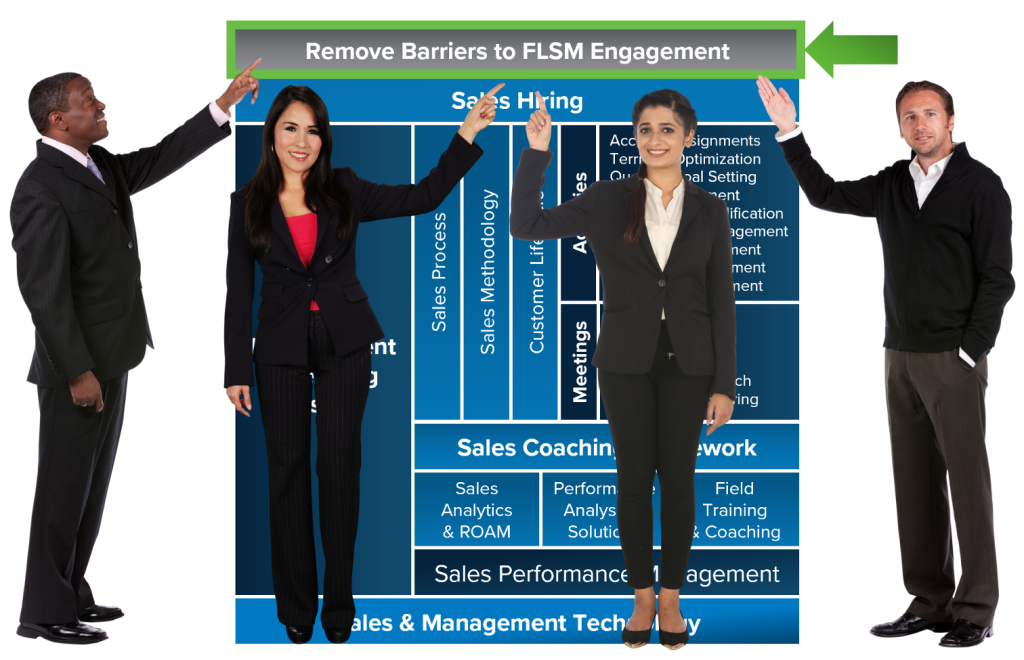
In this post, we’ll focus on identifying possible barriers and offering solutions to minimize or eliminate them.
Barriers & Solutions to Frontline Sales Manager Engagement
This list is by no means exhaustive, and some barriers may or may not apply to your organization. Use it as a guide and consider having an open conversation with your managers to uncover the specific challenges they face and the barriers that prevent their full engagement. Their input is invaluable. If you don’t believe the trust is strong enough yet for open engagement (psychological safety is critical), collect feedback anonymously or have a third-party do it.
1. Poor Role Definition & Misaligned Expectations
Barrier:
Many frontline sales managers are caught between conflicting demands — hitting sales targets, managing reports, attending meetings, special projects, manual reporting, and developing their teams. When their role is poorly defined or expectations constantly shift, managers struggle to prioritize their efforts. This leads to frustration, inefficiencies, and a lack of clarity on their primary function. And it leads to a free-for-all approach to management and coaching.
Solution:
Clearly define the frontline sales manager’s role, with a strong emphasis on team development, coaching, and performance improvement. Ensure alignment across leadership levels and reinforce these expectations through onboarding, continuous training, and structured performance reviews. Then, inspect what you expect and measure what you want to see done.
2. Lack of Clear Prioritization & Conflicting Directives
Barrier:
Managers receive competing directives from different functions — sales, marketing, operations, and finance — all expecting their priorities to take precedence. Without a clear framework, managers are left guessing what matters most.
Solution:
Establish a prioritization framework that aligns managers’ efforts with company objectives. Regularly communicate cascading priorities and create mechanisms for resolving conflicts, such as executive alignment meetings or prioritization scorecards.
3. Meeting Overload & Unnecessary Involvement
Barrier:
Excessive meetings — many unrelated to team performance — consume valuable time, reducing managers’ ability to coach, strategize, and support their teams.
Solution:
Many meetings could be replaced with asynchronous updates. Reduce meeting frequency, limit mandatory attendance, and enforce structured agendas. Introduce “meeting-free blocks” in managers’ schedules and leverage dashboards or recorded updates to reduce unnecessary real-time meetings.
4. Excessive Administrative Burden (Reporting, Compliance, & Lack of Admin Support)
Barrier:
Frontline managers spend too much time on manual reporting, CRM updates, and compliance-related tasks that could be automated or delegated. This diverts attention from coaching and sales enablement.
Solution:
Automate reporting with AI-powered dashboards, streamline compliance tracking, and provide administrative support where possible. If dedicated support isn’t feasible, introduce automation tools to handle scheduling, documentation, and approvals.
5. Outdated or Inefficient Sales Tools & Processes
Barrier:
Disconnected systems, outdated (or missing) CRMs, poor performance tracking and dashboards, and complex workflows create unnecessary friction, making it harder for managers to track performance and support their teams effectively.
Solution:
Invest in integrated, user-friendly CRM and sales enablement platforms. Continuously gather feedback from managers to refine workflows, streamline approval processes, report what really matters through easy-to-interpret dashboards, and eliminate bottlenecks that slow execution.
6. Short-Term Pressure at the Expense of Long-Term Development
Barrier:
Unrealistic short-term sales targets push managers to prioritize immediate results over coaching and team development. This is when managers just fire off feedback, rapid-fire, rather than analyzing and coaching effectively. Leadership often recognizes managers solely for hitting quotas rather than for building sustainable success.
Solution:
This varies based on the maturity of the company, but at some stages, “go slow to go fast” is great advice. Balance short-term revenue goals with long-term performance metrics and developing the team to achieve them. Recognize and reward managers for coaching effectiveness, team development, and skill-building initiatives — not just immediate results. Adjust compensation and performance reviews to reinforce this balance. Every contest, for example, should have a “most-improved” winner, in addition to rewarding volume.
7. Frequent Organizational & Strategy Shifts
Barrier:
Constant restructuring, leadership turnover, and shifting business strategies create instability. Managers struggle to implement long-term coaching strategies when the ground beneath them is constantly shifting.
Solution:
Minimize disruptive changes where possible. When changes are necessary, provide clear transition plans, adequate time for implementation, and ongoing communication to ensure managers understand how shifts support long-term success.
8. Micromanagement & Lack of Trust in Managers
Barrier:
Executives who dictate tactics rather than outcomes undermine manager autonomy. This leads to disengagement, decision paralysis, and managers functioning as task executors instead of strategic leaders.
Solution:
Shift leadership focus to setting clear objectives while empowering managers to determine how to achieve them. Train senior leaders on delegation and trust-building to foster a culture of accountability instead of micromanagement.
9. Overly Reactive Leadership & Constant Firefighting
Barrier:
Leaders who operate in a reactive, crisis-driven mode create a culture of firefighting. I call these leaders “Masters of Disaster” because they usually overreact to the last thing that went wrong, derailing other leaders and plans to tackle the latest “emergency.” This forces managers into damage control instead of proactive coaching and performance improvement.
Solution:
Encourage structured problem-solving approaches, such as root cause analysis, to address issues systematically rather than reactively. Train leaders at all levels to adopt a strategic mindset focused on long-term solutions rather than short-term fixes.
10. Inconsistent or Conflicting Feedback from Leadership
Barrier:
One leader emphasizes coaching, another pushes immediate quota attainment, and a third demands detailed reporting — leaving managers confused and stretched in multiple directions.
Solution:
Align leadership messaging and ensure all executives reinforce the same priorities. Train senior leaders on consistent communication and ensure that middle management is equipped to cascade clear, aligned directives.
11. Lack of Dedicated Coaching & Training Time
Barrier:
Managers are expected to coach but are given no structured time to do so. As a result, coaching becomes reactive, inconsistent, or surface level.
Solution:
Mandate dedicated coaching time as part of managers’ core responsibilities. Reinforce this time allocation by integrating coaching KPIs into performance reviews and ensuring leadership protects and prioritizes coaching efforts.
12. Lack of Leadership Development for Frontline Managers
Barrier:
Many frontline managers are promoted based on individual sales performance rather than leadership ability. Without proper training, they struggle with coaching, team motivation, and strategic thinking.
Solution:
Implement structured leadership development programs that focus on coaching, communication, and team management. Pair new managers with experienced mentors and provide ongoing support through peer learning communities.
13. Over-Complicated Compliance & Policy Requirements
Barrier:
Burdensome compliance procedures and frequent policy changes create unnecessary work for managers, distracting them from high-impact activities.
Solution:
Streamline compliance processes and ensure policies are communicated clearly. Provide quick-reference guides, automate tracking where possible, and solicit manager feedback to refine policies for efficiency.
14. Lack of Recognition & Support from Senior Leadership
Barrier:
Managers who prioritize coaching and development often receive less recognition than those who focus purely on hitting short-term numbers. This discourages long-term team-building efforts.
Solution:
Acknowledge and reward managers who drive sustainable performance through coaching and development. Integrate coaching success stories into leadership meetings and adjust incentive structures to reinforce the importance of talent development.
15. Insufficient Cross-Functional Collaboration
Barrier:
Sales managers are responsible for results but often lack alignment with marketing, customer success, and other departments. This leads to miscommunication, inefficiencies, and a lack of shared accountability.
Solution:
Foster structured cross-functional collaboration through regular alignment meetings, shared objectives, and clear communication channels. Eliminate unnecessary interdepartmental barriers that hinder execution.
16. Leadership Misalignment Between Vision and Execution
Barrier:
Executives may promote a coaching-driven culture in theory but fail to align incentives, reporting structures, and support systems to enable it in practice.
Solution:
Ensure leadership decisions—such as compensation structures, performance reviews, and internal dashboards—are aligned with the goal of developing high-performing teams. Hold leaders accountable for reinforcing the behaviors they promote. Senior leaders need to speak the language of the coaching methodology, as well, and inspect what they expect, even if it’s as simple as asking questions about how it’s going.
Closing Thoughts
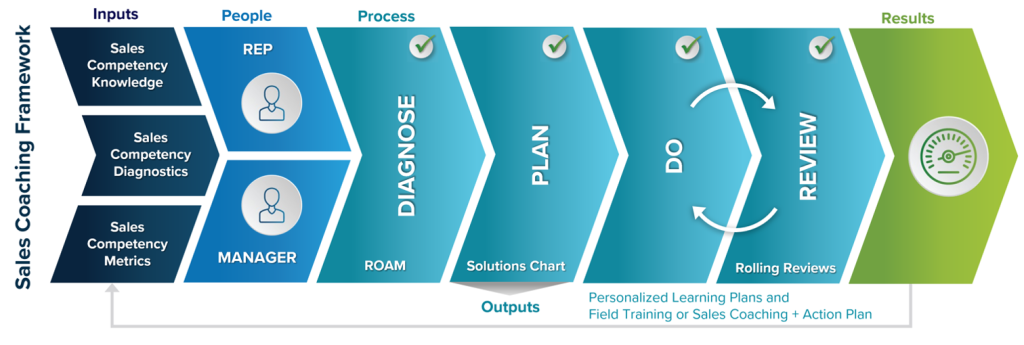
Addressing these barriers requires a commitment from leadership to align strategy, expectations, support systems, and execution, as well as a commitment to remove tasks from managers’ plates that block them from focusing on team development. By creating a structured environment that prioritizes coaching, development, and strategic execution, organizations can enable frontline sales managers to lead their teams far more effectively — and as a result, deliver consistently higher levels of performance (even in tough times).
As you execute, remember these two axioms:
What gets measured, gets done. What gets asked about gets attention and focus.
It’s only when you remove the barriers, measure what you expect to happen, and ask about what’s happening, what’s working, and what’s not, that you will start to make employee development and coaching “the way we do things around here.” You must build it into the workflow and the culture. And that’s when you will see the best results and reap the rewards of your efforts.
Resources
To learn more about developing Sales Coaching Excellence:
- Visit the website: https://bit.ly/SCE-site
- Explore the Digital Solutions Room: https://bit.ly/Review-SCE-Here
This post was originally published as a LinkedIn newsletter, which you can find here.

Previous
Next