

13 Common Pitfalls Sales Managers Should Avoid

Today, I want to share some ideas to help first-time or early-career frontline sales managers avoid the 13 common pitfalls that derail many from being successful sooner in their tenure.
Introduction
While I have always believed in the “Rule of the 3 Ps” (prepare prior to promotion), many sales managers are promoted from sales roles with little to no advance preparation. In some cases, those fledgling managers also receive minimal management development once they are promoted.
In this newsletter edition, we’ll explore 13 common pitfalls that plague many new managers (and frankly, some seasoned managers struggle with these issues, too). When you conquer these, you’ll be ahead of the pack.
For each pitfall, we’ll examine the common mistakes and what you can do instead to become a more effective leader.
The 13 Common Pitfalls

1. Demonstrating Self-interest vs. Team Interest
The first pitfall is Demonstrating Self-interest vs. Team Interest.
This one is probably fairly obvious, but prioritizing your personal gain over the team success will eventually hurt trust and collaboration.
Instead, you should
- Focus on your collective team goals.
- Put team success first to build trust and foster collaboration.
- Always give credit where it’s due.
- Shine a spotlight on your team’s success, including individual team members’ achievements. You may not have something to call out every week, but you should purposefully look for something each week.
- Recognize and reward people based on their preferences. Some salespeople might practically want a parade in their honor, while others may be more motivated by a mention in a team meeting, and some may prefer a quiet pat on the back from you.
While these ideas might sound obvious, shifting to a team focus can be difficult for a few reasons. People who tend to be successful in sales and get promoted to management roles generally have a very strong achievement drive. This is part of what made you successful in the first place. Now, you need to shift focus to your team. You’ll still achieve and be successful, but you’ll do it by getting great results through others – just like we mentioned in the last module.
Catch them doing something right.
Tom Peters
Management expert Tom Peters was fond of saying, “Catch them doing something right.” That’s a great philosophy. Keep all of this in mind, and you’ll do fine here.
2. Micromanaging
The next pitfall is Micromanaging (when it’s not needed).

Micromanaging, or over-managing, is an effort to control everything. For some managers, this is their natural style, but many others resort to micromanagement as a reaction to stressful circumstances when they’re under pressure. Be aware of your tendencies, because micromanagement can hurt creativity, foster resentment, disengage your employees, and cause burnout.
Instead:
- Give them autonomy to do their jobs.
- The Russian quote “Trust but verify,” popularized by Ronald Reagan during his presidency, is good advice for managers. Verifying that an employee has completed a committed task is not micromanagement. Verifying every single thing they do is.
- Only dig into deep details when an employee is not doing what they promised or not achieving the necessary results.
That brings me to the disclaimer above that says, “When it’s not needed.” Sometimes, micromanaging may be needed.
“Your behavior determines my behavior.”
Mike Kunkle
A favorite phrase of mine is, “Your behavior determines my behavior.” When you verify whether something is done and find it’s not, you should ask more questions and “peel the onion” to understand why.
If this happens frequently with one employee, and they are not responding to coaching or counseling, you may need to put them on a performance improvement plan and follow up with them far more frequently than you do with others. This is not micromanagement. It’s micromanagement when it is your normal style for managing your team.
3. Showing Favoritism
Our next pitfall is Showing Favoritism.
This is showing a positive bias towards one or a few team members. If you truly like someone, it’s a natural tendency to want to treat them well. You might want to ride along with them more frequently or give them more public recognition. As a manager, however, you do need to keep fairness in mind, because overt favoritism can hurt team morale.
Instead:
- In a meritocracy, however, remember that “fair” does not always mean “exactly the same.” Equitable does not mean equal. If someone is receiving special treatment based on performance, let it be known.
- Do your best to treat everyone fairly and recognize their contributions objectively.
For example, if there is a top performer on your team, they may naturally receive more recognition than others. This is another place where the saying, “Your behavior determines my behavior” comes to mind. But you can also look for opportunities, as I mentioned earlier, to catch other people doing things right. Reward people when they deserve it and avoid favoritism.
4. Not Setting Clear Expectations
The next pitfall is Not Setting Clear Expectations.
Not setting clear expectations is a definite pitfall and what is commonly referred to in leadership development as a “derailer,” meaning something that could derail your success or even your career. Poor or weak directions will leave your team feeling lost, confused, and rudderless.
Instead, set clear, specific expectations and ensure everyone understands them. You can use the framework of:
- Who
- Does What
- Why
- How
- By When
- And, when it applies, Where
Sometimes, this is referred to as The 5 Ws + H.
In addition, you can also use the SMART goal framework:
- S is Specific – according to my fourth-grade teacher, Mrs. Dietz: “To be terrific, be specific.”
- M is Measurable – you need to know when you’ve achieved the goal or when you’re off track.
- A is Achievable – you can do stretch goals, but even they need to be realistic and achievable, or they will have the opposite effect and demotivate your team.
- R is Relevant – it should be appropriate for their role and tied into the team or company goals.
- T is Time-bound – a date by when you want the goal to be achieved. There’s an old saying that a goal without a date is just a wish.
When I was growing up in sales and sales management, a man named Zig Ziglar was a popular author and speaker. Zig had a saying and story that are relevant here.
The saying is, “You can’t hit a target that you don’t see.”
For the story, he often joked that he could easily beat the best dart player in the world. All he would have to do is blindfold her and spin her around a few times.
I think you get the point. And while this is about setting clear expectations, which is larger than just goal setting, it all ties together.
Keep the 5 Ws + H and the SMART goals format in mind – they will serve you well as a manager.
5. Neglecting Coaching and Feedback
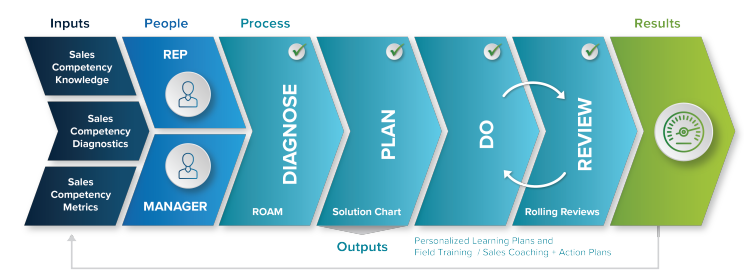
The next pitfall is Neglecting Coaching and Feedback. This is a failure to invest in your team’s purposeful and ongoing development.
What should you do?
Start with a purposeful focus on identifying competency gaps, so you can close them and improve overall performance. This is not random coaching or opportunistic coaching, which I call “coaching by luck.” That’s when you just happen to be with your rep and see something you can help improve. It’s reactive. You want to be proactive.
Here’s how:
- Analyze Results vs. Objectives to identify gaps. When the results aren’t meeting or exceeding your objectives, that’s an area to focus on.
- Diagnose their Activities – or the things that they’re doing (what, with whom, how often, and as applicable, when and where). You can often fix an issue or improve performance by adjusting the activities or activity levels.
- Observe Methodology (sales methodology) – or how and how well they’re doing the activities. This is the quality measure.
This method gets to the root cause of their performance gap.
You’ll notice that Results vs. Objectives and Activities + Methodology forms an acronym of ROAM. Just note that for now; we’ll talk more about ROAM later.
- Next, as appropriate, provide feedback, training, coaching, and/or counseling and create action plans for improvement
- Remember to use the SOIL model for feedback – The Situation, the Observed Behavior, The Impact of that behavior, and the Learning or feedback you want to share.
- Lastly, get into a cadence of coaching and continuous improvement.
I’m going to be honest about something: it makes me groan when I hear managers say, “I’m too busy to coach!” Really? Your entire job is to get the best possible performance out of your team, but you’re too busy to spend purposeful time analyzing performance and coaching for improvement? Don’t allow yourself to fall into that trap.
Also, for clarity, this can be done with poor performers, average performance, and top performers on your team. Sometimes it’s about fixing a problem, but not always. It can also be about helping good performers get to their next level. Coaching was important to mention here because neglecting it is a major pitfall.
6. Avoiding Conflict
Next up is Avoiding Conflict.
This means to avoid addressing issues, conflicts, disagreement, tough conversations, and especially poor performance. Avoiding conflict allows problems to grow, hurt morale, and disrupt the team.
Instead:
- Don’t let things fester, whether it’s a?performance issue, disagreement within the team, or a struggle accepting a new policy or change.
- Give people a chance to address conflict themselves, and even encourage it, but be ready to mediate team disagreements as needed.
- When you do address performance issues, do it humanely, calmly, supportively, and professionally – but do address them.
- It’s always a good idea to address behavioral issues with your manager and HR. I hope you don’t have to deal with harassment in any form, racism, sexism, or other inappropriate workplace behavior. But it is a reality of management. If you’re witnessing something, you may need to stop it in the moment. Before you address it officially, though, get your manager and HR involved. You may have separate training available to you on these topics, such as inappropriate workplace behavior and how to handle it, in more detail. If you do, please take advantage of them.
- Lastly, change sometimes creates conflict. This is not news – you know this. When announcing or reinforcing necessary changes, explain them clearly, and especially share “the why” behind the changes. Hear people out, and if they have valid concerns, you may want to advocate for them privately with your manager and pass the feedback along, but be firm on expectations with your team, unless the changes are revised.
In all cases, though, remember that as a manager, you’re a lot like a first responder, such as a firefighter. You don’t avoid conflict – you run toward the fire.
7. Failing to Build Relationships Proactively
The next pitfall is Failing to Build Relationships Proactively
This means failing to purposefully develop professional relationships with your team. We all know relationships are important, but for some reason at work, we often don’t have a strategy or intentional plans on how we will build or improve our professional relationships.
For example, you probably – or hopefully – have intentional plans to deepen relationships with contacts in your key accounts. You should have the same purposeful plans for your team members.
I’ll share two things that will form a strong foundation for this and then layer six others on top of that foundation.
- First, demonstrate your Worthy Intent. Worthy intent means you have their best interest at heart. It means that your actions are in their best interests.
- Next, you want to build on a foundation of that we call CIA: Credibility, Integrity and Authenticity.
By the way, these concepts come from another course we teach, called Relationship Quotient. It’s based on the book and teachings of business relationship expert, Ed Wallace. So are the next six concepts. Let’s take a deeper look.
In addition to Worthy Intent and CIA, you can:
- Establish Common Ground: What are the connections between you and the other person that initiate rapport?
- Get to Know Them: What are their values, motivations, reasons for wanting to succeed? What is their GPS or Goals, Passions, and Struggles? And within reason, at work, you can get a little personal, too, by asking about their weekends, family, vacation plans, and more. It’s like the old sales advice, “Show Me You Know Me.”
- Display Integrity and Trust: How do your daily actions confirm your intent and strengthen the relationship?
- Use Time Purposefully: How will your treatment and investment of time build the relationship? Do you spend enough time supporting and coaching them?
The last two are about helping, and it’s a two-way street.
- Offer Help: How will you share expertise and support to advance the relationship?
- Ask for Help: Can you ask the other person for help? Can they do the same with you?
These are solid principles to build the best-possible relationships with your team. They are also great principles in general, to develop even better relationships with your customers.
8. Telling vs. Facilitating
The next pitfall is Telling vs. Facilitating (especially when facilitating is what’s really needed).
Many managers are in the habit of firing off quick advice,?feedback, or instructions. They tell and explain far more than they ask or facilitate. I understand why. It’s a problem that busy people face.
Instead, I’m going to ask you to think about similarities between the sales role and your role. We tend to focus on the differences between selling and managing, but there are some great parallels.

You do discovery and ask questions to clarify with your customers, right? Now, you should transfer that same behavior to your team.
- That said, telling is appropriate when someone doesn’t know what, why, or how to do something. But that’s not 100% of the time.
- Normally, you’ll want to ask questions, get your employee engaged in the discussion, and guide your employee vs. just telling them what to do, or firing off feedback.
- You can often help people solve their own problems by leading with questions and engaging them. People feel ownership of decisions, solutions, and action plans, when they participate in making those decisions or building the solutions and action plans.
9. Focusing Solely on Results vs. Activity + Methodology
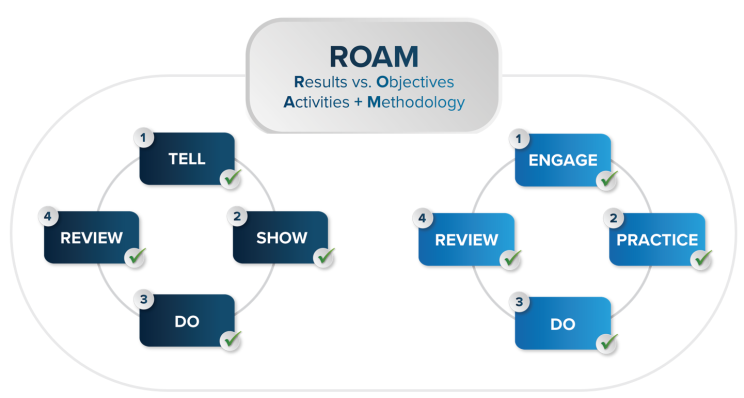
The next pitfall is Focusing Solely on Results vs. Activity + Methodology
This might seem like a mixed message because I’ve often said that management is getting results through others, and that the primary objective of management is to get results. None of that has changed, but I want to add some perspective.
Results are critical but a focus only on results is short-sighted. Results are a lagging indicator. By the time you’re looking at them, you can’t change them. You can only influence results by focusing on how someone is attempting to achieve them (their activities or the leading indicators).
So, what should you do?
- Balance the focus on results with attention to how those results are achieved.
The ROAM model, which I mentioned earlier, is really helpful here.
- Start by comparing Results vs. Objectives. This identifies shortfalls and where to focus.
- Then you can dig deeper. First you review Activities. This means what they’re doing, with whom, how much or how often they’re doing it, and if it matters, when and where. These Activities are leading indicators. You can explore them to predict the results, which are the lagging indicator. Sometimes, you can resolve a performance problem or just improve the performance of a good performer by honing the activities and activity levels.
- But if not, you next should observe the Methodology. This is short for sales methodology, or how and how well they’re doing those activities. I like to explore this even if the activity adjustment improves performance, because the methodology adjustments may improve results even more.
In either case, this ROAM model helps you diagnose the root causes of a performance gap or potential improvement, allowing you to train and coach to higher performance. This model will serve you very well as a manager.
10. Not Managing Up
The next pitfall is Not Managing Up
This means that you’re not in sync or aligned with your own manager, which can lead to miscommunication, awkwardness, and missed opportunities for support. It can also hamper your relationship with your manager, as well, or at least not optimize it.
Here’s what you can do, to effectively “manage up;”
- Proactively communicate with your manager. Keep them informed – and especially help them avoid surprises, particularly when it’s bad news.
- Work to understand your manager’s priorities and anticipate their needs. And yes, it is absolutely okay to have a conversation about this, especially as a new or newer manager, or when you switch managers.
- Advocate appropriately for your team. This doesn’t mean complaining negatively on their behalf but having authentic discussions. A leadership development friend of mine is fond of saying, “Leaders communicate their intent early and often.” This often involves explaining why you are sharing the feedback or situation. It will definitely help.
- Observe their style and adapt to it, as best you can. If they communicate in three bullet points and you communicate in three long paragraphs, you’re going to miss your mark or wear them out. Or if they prefer a phone call or meeting for two-way communication and you love email, it’s going to be a bumpier ride than it needs to be. Try to adapt, with the realization that some important discussions won’t fit on the head of a pin or be three bullet points. That’s where explaining the why and your intent will be helpful.
- Proactively request feedback. Ask for feedback on your performance and how you can improve. Also, ask for feedback and advice on dealing with your team, as needed. Your boss may or may not use a model like SOIL, but through discussion, you can pull out the SOIL elements from them. As a reminder, SOIL is Situation, Observed Behavior, Impact, and Learn.
- Be open to constructive criticism and avoid defensiveness. View feedback as an opportunity to learn and grow, which is one of the foundations of a growth mindset. Leadership expert Marshall Goldsmith says to think of it as feed-forward – something you can use to improve and grow in the future.
11. Failing to Prioritize Effectively
The next pitfall is Failing to Prioritize Effectively
I’m sure this one comes as no surprise. Trying to tackle everything at once scatters focus and reduces effectiveness. There are only so many hours in a day. Focusing on everything generally leads to accomplishing nothing.
“When everything is a priority, nothing is a priority.”
Karen Martin
Instead, do something to keep yourself on track, as well as clearly communicating priorities to your team.
There are a variety of prioritization frameworks to focus on high-impact tasks. Let’s take a look at a few.
- Big Rocks: Some people use the Big Rocks method. This prioritization method, popularized by Stephen Covey, is?a time management technique that focuses on prioritizing the most important tasks first. It likens prioritization to putting rocks in a jar. If you put the small rocks in first, there may not be room for the big ones that really matter.
- Eat the Frog: The Eat the Frog method recommends putting your most difficult task first, especially if you’re dreading doing it. The idea is that once you eat the frog, the rest of the day seems a lot easier.
- Eisenhower Matrix: One of the most commonly used priority matrices is the?Eisenhower matrix.?It divides tasks into four quadrants:
- Urgent and important: These tasks need immediate attention. Complete them first.
- Important but not urgent: These are strategic tasks that contribute to long-term goals. Schedule them in advance.
- Urgent but not important: These tasks are distractions. Delegate them if possible. If not, complete them as quickly as possible.
- Not urgent and not important: These are low-priority tasks that can be eliminated or done last.
There are many more methods and you can certainly research them, but the last one that I’ll mention is something that has helped me a great deal, over the last 15 years or so. It’s called Timeboxing.
- Timeboxing: This is a technique where you allocate specific time slots to specific tasks. It’s like setting an appointment with yourself to get work done. Doing this creates a focused period for each task, which helps you avoid getting overwhelmed by your to-do list. Begin by estimating how much time each task will take. Then, block off those time slots in your calendar. I quit using a to-do list years ago and exclusively use timeboxing.
But that’s me. You’ll need to find what works best for you, or maybe you already have. If not, though, ensure you do something to prioritize as best you can, and help your team do the same.
12. Forgetting to Celebrate Small or Incremental Wins
The next pitfall is Forgetting to Celebrate Small or Incremental Wins.
This one is so easy to fall into. Some managers only celebrate big milestones or big wins. Unfortunately, they miss a lot of opportunities to boost morale, sustain momentum, and even support positive behavior change.
What should you do?
- Make a purposeful effort to acknowledge and celebrate small wins regularly.
- Use shout-outs, informal recognition, or team celebrations to keep motivation high.
- Remember to reward and reinforce incremental successes along the path to the larger goal. Research on workplace behavior has proven that this works. Reward progress toward a goal, as well as the attainment of the goal, at the end.
Separately, this is also why I always include a Most-Improved category in any contests. There are good performers who will never land in first, second, or third place in a contest. For them, the contest is not that motivational. But with a most-improved category, everyone has a chance. Most importantly, whether or not you use contests, remember to celebrate small and incremental wins. It really does work.
13. Jumping into the Sale (aka, “The Super-Seller Save”)
Well, here we are, the final pitfall – unlucky number 13. The final one is Jumping into the Sale – also known as “The Super-Seller Save.”
Managers who are guilty of this pitfall consistently jump into their sales team’s opportunities because “they needed you” to make the sale. Whether or not they really did.
When it makes sense
Look, there are times when stepping in to help and even taking over could be necessary.
- If your rep is delivering incorrect information about a product, services, or terms, you should ensure the customer has the right information. In this case, you shouldn’t need to take over. Instead, find a way to introduce the correct information without throwing your rep straight under the bus.
- If you observe unethical or inappropriate behavior from your rep, stepping in and taking over is warranted. You can address the situation privately afterward.
- This one is a bit squishy, but if you truly believe that the scenario that’s unfolding in front of you is going to result in losing a key account, you’ll have to reply on your best situational awareness and judgement. You’ll need to decide whether to jump in and help briefly and use it as a coaching moment later – or jump in and take over the conversation entirely.
So, yes, there are legitimate reasons to step in and even to take over. But in over 40 years in the sales profession, I have only seen or heard of a handful of cases where the manager truly needed to take over the sale. Stepping in to help, or speaking up to interject, I’ve seen far more often. But it was more of a team-sell approach, than the Super-Seller Save.
What to do instead
So, what should savvy managers do instead?
- Pre-Brief Before Sales Calls: Before key meetings, coach the rep on potential challenges and strategies, so they feel equipped to handle them without relying on intervention. This won’t solve everything, but it helps.
- Redirect Instead of Rescue: If the rep is veering off course, steer the discussion subtly by reframing their point or introducing a new perspective without overshadowing them.
- Interject the Right Questions: Instead of taking over, prompt with strategic questions that guide the conversation in the right direction and then – step back out.
- Team-Sell with Purpose: If speaking is necessary, interject briefly – adding relevant insight that enhances the conversation – then hand it back to the rep.
- Use Post-Sale Coaching: After the call or meeting, discuss what went well and where improvements can be made. Offer positive and constructive feedback afterward, rather than taking over in the moment.
I hope this advice helps. I know this can be tough for new sales managers. Most people that are promoted to a frontline sales manager role were an outstanding salesperson. They’re above average. If you’re watching this video, you’re above average. And it’s likely that not all of your sellers have the skill set that you do.
So, it’s very tempting to jump into the sales arena, where you’re the most comfortable and confident, being that super seller. But unless it’s truly necessary, doing it far too often will have a negative impact on morale and teach your sellers to rely on you rather than to work with you to improve their own skills.
Use your best judgment, interject when it makes sense, take over if absolutely necessary – but try to avoid the Super-Seller Save as much as you can. Your team will thank you, even if they do it quietly.
Closing Thoughts
Stepping into a frontline sales management role is both an exciting opportunity and a significant challenge. The pitfalls outlined here aren’t just theoretical – they’re the real-world hurdles that can trip up even the most talented new managers. But as you’ve seen, every common misstep has a practical, actionable alternative. The difference between struggling and thriving often comes down to self-awareness, intentionality, and a willingness to grow alongside your team.
Whether you’re a sales enablement leader guiding new managers, a sales leader building your bench, or a first-time manager yourself, remember: mastery in management is a journey, not a destination. Embrace the learning curve, lean into the tough moments, and celebrate those incremental wins along the way. By focusing on team success, building trust, and investing in your people, you’ll not only sidestep these pitfalls – you’ll set the foundation for an engaged and high-performing sales team.
This post was originally published as a LinkedIn newsletter, which you can find here.

Previous
Next